
Microsoft Fabric is a Team Sport – Ep. 328
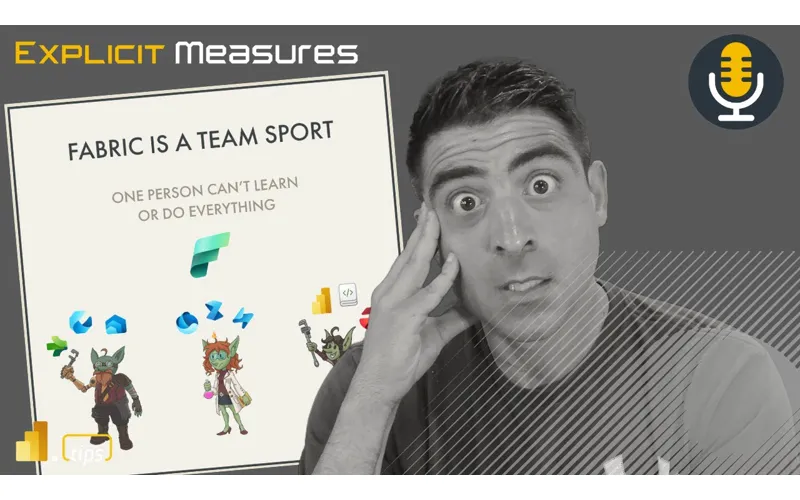
In this episode of Explicit Measures, we discuss Microsoft Fabric is a Team Sport and what it means for Power BI practitioners.
News & Announcements
- Power BI enhanced report format (PBIR) in Power BI Desktop developer mode (Preview) | Microsoft Power BI Blog | Microsoft Power BI — Enhancing team collaboration and automation is crucial for any enterprise BI development, which is the primary goal of Power BI Desktop developer mode. The Power BI enhanced report format (PBIR) for Power BI Project…
- Fabric is a team sport — DATA GOBLINS — In this article, I share some unfiltered thoughts about why it’s unrealistic to expect one person to know everything in Fabric, and concerns I have about unrealistic expectations being put in the market regarding Fabric.
- PowerBI.tips Podcast — Subscribe and listen to the Explicit Measures podcast episodes and related content.
- Power BI Theme Generator — Create and download Power BI report themes using the PowerBI.tips theme generator.
Main Discussion
The main discussion is built around an article arguing that Fabric is a team sport—and the team agrees. Fabric collapses a lot of capabilities (engineering, modeling, governance, DevOps) into one platform, which means a single “Power BI person” can’t realistically cover everything at scale.
Key points:
- Successful Fabric adoption needs multiple skill sets: data engineering, semantic modeling, security/governance, and platform administration.
- Clear ownership matters—decide who is responsible for pipelines, quality gates, permissions, and cost management.
- The episode also highlights how the evolving PBIP/PBIR formats unlock better source control and collaboration, but require real Git practices.
- Standard conventions (naming, workspace/domain structure, reusable models) prevent chaos as the platform grows.
- The best “team sport” move: start small, prove the workflow, then expand the roster.
Looking Forward
A good next step is to map your Fabric responsibilities to actual people (or gaps) and pilot a repo-based workflow (PBIP/PBIR + review/merge) on one report/model. Once the collaboration model works, scaling Fabric becomes much less painful.
Episode Transcript
0:25 good morning and welcome back to the explicit mes podcast with Tommy Seth and Mike Mike hello every good morning good morning we were having an interesting conversation we’ll get into our main topic today so I’ll just do a quick introduction our main topic today is an incredible article again from data goblins K Piller the fabric expert and debunking is fabric actually not debunking but like talking through the the idea that fabric is a team sport you need many people who know many different
0:55 need many people who know many different things in order to make fabric run well in your organization so I definitely have some really good talking points I feel like I have some strong opinions around this article so this will be interesting I’m see where this goes anyways that being said let’s talk about our intros so Tommy was informing me just before the podcast here I apparently I missed out on some of my childhood so so who is this so Tommy brings up this artist this morning and I don’t know I don’t have a clue who this
1:25 don’t know I don’t have a clue who this is their name was They Might Be Giants they were never on the radio but they somehow got very popular these just two nerds and you look at them and they were best friends nerds and they could also just play music so some of their hit songs were was like don’t let start and that’s the actual words don’t let start this is the worst part I am Dr Worm they were the intro to Malcolm in the Middle they were also in the
1:59 the Middle they were also in the Looney tunes for kids they had a lot of songs there you just didn’t know it see I don’t know who these guys are I don’t I’ve never I probably heard their music before but I just it’s not ringing a bell and I’m not like oh that’s exactly what it is the only the only one of their songs that obviously earworm into me which was there Istanbul Istanbul and and that is one that I was able to crack off right right before the podcast so I won’t torture the list I’m
2:30 podcast so I won’t torture the list I’m going to have to go listen to these guys I don’t I feel like I’ve missed out on this like I didn’t watch mock in the middle so I didn’t I don’t know about that from there and so the only thing I can remember growing up kids songs that I always remember it was like Baby Beluga like that was like was that Rafi I think is is the name of the artist yeah I don’t think that was They Might Be Giants though no but I’m just saying that’s from my childhood that’s like one of the kid songs that I remember growing up with yeah raffy yeah they’re but they’re not a kid’s band and
3:00 they’re but they’re not a kid’s band and I guarantee you out of our audience too probably 20% are major fans of them the other 80% have never heard of them did so I’m going to ask chat that’s exactly right now so chat if you’re there and you’re listening did you ever hear of They Might Be Giants and did you did you watch them growing up just give me a just give me a shout out here I’m just curious see if anyone actually pings us back here and say oh yeah that was great so and maybe maybe this is just a Tommy thing it maybe a Seth thing so and there probably all our listeners that are not here live anyway so we’ll never find out
3:34 shout Into The Ether yeah shout at your shout at your podcast that you’re you’re you’re you’re running around with someone’s running like they’re my favorite Tommy’s gonna build us a a podcast playlist and this will have to be on some of the playlist yeah when we actually run our own conference or power B concert this will be the intro song for our our stage presence yeah when we when we go on the stage we’ll play some awkward songs as we get on stage that’s incredible awesome let’s jump into our main
4:06 awesome let’s jump into our main actually we have some news yes S I forgot yes that was the other one idio sqlbi in the chat Particle Man Particle Man partic Particle Man does everything a particle can I can get behind that one that sounds very sciencey to me it is a great song that’s right oh I was looking for that yes sorry okay I’m that’s what I’m saying going away if somebody pops in another one in the chat I’ll be like yeah I did have their CD I know I did that’s hilarious anyway awesome great
4:38 that’s hilarious anyway awesome great songs I dig it good little intro there so another big intro here is Tommy we get a great blog announcement from ruy romano and ru’s been doing this thing called the pbip or the PB formatting of our power files it’s helping us break apart the files into more granular pieces all right Tommy where are we at what’s what’s this new update and what is ruy blogging about because this thing looks well I know where we’re going but I love this feature yeah so speaking of nerds
5:11 this feature yeah so speaking of nerds what if you loved powerbi but hated the user interface that’s basically what the PBR file format is and I know it’s been out for a while so I don’t think Ru said anything was groundbreaking or that is g but it was really just this deep dive of really how to actually use the PBR format it can be very intimidating when you first look at it because it could be so easy to break or modify your model the only time you’re really going to be using PB is in
5:42 you’re really going to be using PB is in G A git type of environment this is not something you’re probably going to be doing with SharePoint it actually now allows your model something more familiar to get so when you actually push things through now what they’ve done with the PBR format is how they’ve organized basically the entirety of your semantic model both from the folder structure and also from the coding point of view it really allows perfectly for Source control and actually see where changes may have been so Ru just goes
6:15 changes may have been so Ru just goes through in the blog article basically here’s the format here’s how to view it and here’s actually to do that Source control with the PBR format yes I I’ll say I agree with you but I think there’s a bit more in the article so the pbip format has slightly changed over the time that it’s been out so the format originally was oh yeah one large Json object for all things in the report it would just it would it give you just a report
6:45 it would it give you just a report object for everything in the report it appears as though now the PB format or this enhanced PBI format they’ve been evolving how things are being built so if you remember back in the day when we had tabular editor doing save model as folder or save Model S files you could take an entire file and it would take the file and deserialize the the Json object the model. Bim it would serialize it into a series of smaller files here’s a table definition here’s a here’s all these different pieces of
7:16 all these different pieces of the model so it what it gives you the ability to do is it gives you the ability to check in check out portions of a model so for example think about page one page one contains visuals inside those visuals You’ have properties and objects and things that would describe those visuals what this does is this gives you a in the page a single item by item object that you can go modify so this will give you better control around or detection essentially
7:47 control around or detection essentially if you have a team of people and this fits very well with our conversation today when you have a team of users building reports together if someone adust adjusts page one you should be able to see changes occurring on page one when those changes are being checked in so this is a way better format and the fact that this is now being somewhat documented and there’s now a structure to it and we have these different files this is going to make it way easier for you to even merge changes as well you could totally imagine two people working on two different pages and bringing those pages together and having a single merged Report with two
8:18 having a single merged Report with two pages now being joined as one report but two different people working on it this is a huge move that Microsoft’s making here so I’m a little curious though because he did mention timle which is not what this is because timle was is going to be the language basically for a semantic model more in the AML format but they’re really focusing here on still technical it’s Json where does
8:48 technical it’s Json where does timle fit in all this yeah so timle is interesting so tmdl tabary model definition language this is all around a language that defines a data model there are different things that need to be speciic to the data model yeah it’s specific to data models only and to be honest the report side it can be represented as Json or yaml very easily so yaml is yet not another Market language it’s more of a human readable Syntax for how things are being built
9:18 being built the the the objects of the report are not required to have very creative conventions I guess I would say like so for example like inside a model definition you have comments that support a measure so there was a way of representing that differently so you have three slashes backwards to represent a comment for a measure a measure has Dax so there’s like there’s like another language inside timle that has Dax and M and so
9:49 timle that has Dax and M and so what the timle language has to be able to do it has to be able to obey okay this is an this is a data source here’s the M code and it needs to be able to be formatted in a way that the timle understands that hey this is a distinctly different language you can
10:02 distinctly different language you can write that inside timle format and still have it be read by the the desktop so timle is slightly unique it has like it’s like an enhancement of yaml it’s like a different language that’s more enhanced that has more features specifically for data model design does that make sense yeah yeah so I oh kirp article today maybe maybe we are maybe we are anyway what I what I like about this obviously this is a like the hardcore bi Dev like I want to
10:33 the hardcore bi Dev like I want to replicate I want to I want to build in code or or create repeatable objects in a faster way y and it open up opens up I think a lot of the visualization visual control or pre- settings to start a a PBF like start a report which I I love so I I think it’s a it’s a another big step in the direction of having true Dev Dev code experiences to help facilitate triage and
11:05 help facilitate triage and deploy code which is essentially the reports that we we build in many cases for customers and to be clear one of the big one of the big challenges we’ve always had has been when you go down to the visuals level in a report in the existing even in the old pbip format there was a whole bunch of string stored as text that is no longer a case anymore now we have full Json object in all aspects of the storage of the data here so this is really really a big move here by Microsoft there is no
11:36 big move here by Microsoft there is no longer any string stor as text I think as I’m opening up a file here most of the visuals and all the properties of the visual if there’s text in the visual if there is properties in the visual all the things that you would care about of the settings of the visual are now full searchable Json what this enables us to do is this this I think this is I think this format is going to enable a proliferation of tools that are going to be generating reports programmatically we already use this format in our theme generator to do this so this is a format that we’ve been
12:06 so this is a format that we’ve been taking advantage of for over over a year now I think it has been Seth that we’ve released the feature but we now use this feature to help us produce reports that it can be just wire framed you don’t really need to open Desktop to build a structure of a report you can do all the styling separately and that’s what we’re using we’re using all the stuff here separately yeah one one one thing to point out there are there are so certainly check out the article there are limitations to the PB right Ed not there yet they they’ve
12:39 right Ed not there yet they they’ve called out specific things that they’re going to be working on or deploying shortly but they do state in there once you go PBR format you can’t revert right so whatever you’re going to go for from the pbiip Save A a version of that and that’s even more called out because as a brand new thing gets out there Nate hering says watch out and and he tried that the PPR format and all his bookmarks got wiped out so he’s
13:09 his bookmarks got wiped out so he’s reverting until they fix that or I. E hopefully he has a different he has a backup backup good yeah word of caution and I’m gonna put in here as well so Brewery actually does call out and even in powerbi desktop so when you switch over to a file and say I’m going to save something as a PV format there are some limitations that are changing or there are limitations right now while it’s in preview these might get worked out and might change over time but in the chat is the link for any of the
13:39 the chat is the link for any of the limitations that are around the PB format which is very important that you read through those and understand what’s going on there like for example service limitations a PBR format can’t be included in in powerbi apps it can’t be downloaded as a pbix it can’t be exported to a PBI or P PowerPoint P PTX or PDF PDF can’t be included in subscriptions so these are like feature gaps that this is there’s a lot of structural changes it looks like it’s happening on this file format that’s
14:10 happening on this file format that’s impacting the power. com service and I’m guessing they’re going to continue closing these gaps as they use this new format for everything moving forward so excited about the new format it is in preview so be very aware using it will have some limitations but that being said it’s going to be very useful I think in the future here so this this is really really helpful great find Tommy on that article glad you caught that when it came out the discussion really builds well into our our Tuesday conversation too which is hilarious this
14:40 conversation too which is hilarious this a that was a hot take that came out early this morning yeah it’s it’s the 13th it came out it literally came out this morning with the news so ruy posted it and we caught it right away yay you heard it here first on the explicit measures podcast well yes true all right let’s jump into our main topic then so main topic today is an article written by Kurt which Kurt thank you very much for jumping in the chat as well so Kurt is with us today so hopefully we’ll get some good chat here
15:11 hopefully we’ll get some good chat here as well from from Kurt additionally we’re going to go through an article from data goblins and I’ll put this one here as well and it and it talks Prim early around what is a fabric expert how do we Define a fabric expert I think we’ve touched on this a little bit in some of our podcasts and given some kind some of our podcasts and given some recommendations or pieces around this of recommendations or pieces around this I feel like this has been a hot topic for us recently but I’m really I think this this article is very timely at this point so before we get before we jump into anything and How Deeply you guys read the article Mike Tommy are are you
15:41 read the article Mike Tommy are are you guys fabric experts I’m wearing a fabricator shirt so I feel he’s pretty well into it yeah so I’m wearing I’m I’m a genuine fabricator is what my shirt says so maybe a an underwe yes underhanded way of saying maybe maybe I’m not okay I feel like I’m going I feel like I’m going to some there are some aspects of this article I’m going to disagree with I’m going to let right now there’s some some challenges here I’m I’m thinking is here there is
16:14 I’m I’m thinking is here there is some strong language used not bad language strong language used in the article that I think should be a slightly bit softer many of the points here I 100% agree with and so there’s a lot of things I align with so when I call myself a fabric expert I’m going to have to gauge this it’s like a it’s like a spectrum it’s like a scale right it’s know nothing about fabric know everything about fabric right where do I fit on that scale so I would say I would push myself farther down the I know a lot of things about fabric so I maybe you could qualify me as an expert in fabric do I
16:45 qualify me as an expert in fabric do I know every single thing in fabric probably not every single thing if you push me towards the kql databases and the real-time streaming stuff that stuff’s new other people have been doing that but that’s its own industry there’s an own subject matter area around that specific topic that other people have been involved with like have I done things with a vent hubs yes I have that’s an Azure so do I have some exposure to it yes I do but have I done 20 30 projects in just streaming analytics stuff no I have not so like that would be one of
17:15 have not so like that would be one of the areas where i’ would say I’m I’m less strength around that one but have I done projects with streaming things yes I have we’ve done data from source to reports in under two minutes like we had a requirement we did it so like I have some experience there as well I think I think that’s that your answer is a good good segue into the article and and I think it it is where on a high level I I agree with you some of some of that so where do we want to
17:47 that so where do we want to start well let’s start with I’m going to start with the very first quote that he puts on here one person can’t learn or do do everything fact fact so I agree with this but I do think there are people out there that are actually studying Fabric and I do think there are people out there that are going to try to educate or at least have some experience or knowledge around all the aspects of fabric so this is maybe one of my talking points there so so I I
18:18 one of my talking points there so so I I agree and I think context matters right if I holistically if I’m looking at the article I I do I do definitely feel that there’s some more oomph behind behind behind this one than than some of the others if I’m if I’m a business looking at individuals that are like powerbi people and and then the business has an expectation all
18:50 then the business has an expectation all of the sudden because they’re reading that everything all of these tools in this whole ecosystem are right next to each other and it’s so simple to do what you even describe right now is I can do this in two minutes that doesn’t mean that that person can right and and and I think part of this article is going to be around are there technical people like you Mike are there technical people like Alex powers that can walk into organizations and they can take
19:20 organizations and they can take something that took three weeks or three months and and we can say this now takes five minutes in fabric watch me and you can do that hold my beer but you’re an exception to to the norm does that mean other people can’t spend the years it took you to get to the point that you are to understand this whole ecosystem and rapidly develop these Solutions across the platform like no it took you a long time because you understood these
19:52 a long time because you understood these Services before they were even combined correct I think that’s the overriding like line in here where you’re not normal you’re you’re you’re a special unicorn and we we col thanks Seth we
20:08 unicorn and we we col thanks Seth we collectively have had experiences in Big Data Systems in powerbi in Azure data Factory in oh my goodness all of the services that got combined together in fabric but if you’re just that Excel user Mike before you started Consulting 10 years ago or whatever yeah and you’re a powerbi person and now you have access to fabric and your previous employer looks at you and goes well we no no longer need all of these other people because all these services are together
20:38 because all these services are together hey Mike you’re the person do you can you fabric is is that a reasonable expectation from an organization so I like I like your I like your your dive into the topic here because I think this is exactly where I’m going with things here a little bit I really do agree I agree with this a lot Seth in this statement I like and I like where you’re going with this one as well so if I I think I am not a normal person
21:11 so if I I think I am not a normal person because I I’ve tried to be very intentional I think Tommy you to as well right we have tried and Seth for most degree here you’ve tried to like as an MVP a Microsoft MVP you study what the tool does so you can be like it interests you it’s exciting to you you have like and I’d also argue too we all have people that we know or or team members that help us do everything in in powerbi I get a lot of calls from other MVPs or other experts in the industry that are saying hey Mike how to do embedded I got some questions for you they know that I know how to do embedded
21:41 they know that I know how to do embedded really well because I have done a lot of work with it but do I expect every business user who’s coming from Excel to know how to do powerb embedded no I do not and I think that’s to your point Seth is like what’s the context of the article I think this article and if you if you take this article with the context of I’m in a business and I’m pushing EX existing powerbi individuals and giving them more fabric the the expectations not taking a dp600 will give make you an expert it will not it will not take you from zero knowledge of fabric to 100% and now
22:12 knowledge of fabric to 100% and now you’re capable I don’t think there’s a single test out there that would give you that but to your point Seth Tommy and I you we’ve all been spending time studying the tool and this is part of where I think I disagree with the article a little bit there’s a lot of strong language around it’s there’s I think there’s a couple phrases in here that just rubbed me the wrong way and it just felt a little bit too Stark to me I want to be I want to give people the ability to like learn and I feel like I want to give people a bit of the benefit of the doubt and the fact that there’s a couple sections in
22:42 fact that there’s a couple sections in here where it says oh here this is there’s this point down here there’s no such thing as a fabric expert I would disagree with that statement I think there are experts in fabric question to you in the beginning yeah it’s the question at the beginning is there there’s is there no such thing as a fabric expert I’ve would agreed most probably know in every single thing but I think it’s also important that experts that do show up quantify where they’re at and also in my team there’s a team of people behind me who are also Consultants that also know
23:12 are also Consultants that also know various aspects of fabric as well so if I don’t know I have someone on my team who’s done or dealt with some things as well that are very relevant and I have knowledge I can pull on to get the answers that I need to get to to answer these questions and I this is where I got I got a little bit more hesitation in the article right is if someone is claiming to be a fabric expert there are two things that are true they are intentionally lying or misleading you and they are ignorant on how big fabric is in the differences and skills needed to management and I would
23:43 skills needed to management and I would agree like I don’t agree with that statement a little bit I I think internally looking maybe but I think there are people out there that are going to study this and I think that’s a naive statement because I do think people are going to go out there and figure out how to use every part of Fabric and understand that it’s valuable to them I think I need to stop you right there because like this goes back to a point that I’ve been saying all along if you took out fabric from the entire game our like Mike our careers have been
24:14 our like Mike our careers have been built on powerbi which has now just become not a CO like necessarily a cog in the machine but has definitely gone down and not to like like a subfolder before when it was in the entire basically the entire application and we could survive both in a career or as a consultant just doing powerbi for organizations building the reports managing the data that was and how much do you need to know just due to that and
24:44 do you need to know just due to that and what what SE was talking about how many people do who are actually going to consume powerbi like we did it’s not a lot of people and you’ve literally just multiplied that by six so to speak with each of the other products now in fabric powerbi is still powerbi like powerbi hasn’t they didn’t like take any features away from the powerbi application granted there’s there workflows but I digress and how much time have you spent it’s my waking
25:16 much time have you spent it’s my waking hours since 2015 since I was some 20-year-old SCH has been learning about powerbi and I could always get more information and I could always find a new blog and I could always learn something I could be a lot better at passionated reports still there’s still a few Dax things there I know what you’re saying Mike about like I also know like I have a great network but you are now taking something that powerbi which has consumed our waking days and now open it up to other careers
25:50 days and now open it up to other careers and other worlds that of people just that’s all they did too without the need for powerbi without the need for data if you’re a data SCI scientist so just from a Time point of view I get that I can I can lean on people and like I said I know you I there’s a great Network that we’re already a part of but I’m more worried about organizations just saying yes someone can get away with doing fabric just like they’ve been doing with
26:21 just like they’ve been doing with powerbi and I think that that same that I guess that same stereotypes to speak is I think going to hold true a little I think I think that the the learning curve for powerbi is is much lower right and and there’s a lot of value you can get out of it as a non-technical person I I think this does highlight that fabric introduces lots of Technical Services that are all slammed together and it’s
26:52 that are all slammed together and it’s being presented that all of the sudden this is simple and this is easy or there are better path and and to some degree that is true it’s a true statement but it oversimplifies I think the complexity of what’s happening within fabric here just because you slammed all this together doesn’t mean that it automatically simplifies the learning path for individuals right the capability of fabric does not mean that you can automatically Implement
27:22 you can automatically Implement effectively right there are no fabric experts as it relates to every single one of these Technical Services across the board it would take years right like Mike would you say that from each of these Technical Services you understand them all to the level that you do powerbi or to the level that lakes or like yep the of course not not right from things are coming out all the
27:52 right from things are coming out all the time perspective yeah I 100% agree with this article but it’s not like that’s there’s also mixed tones across the board from being a 100% technical expert in all of these things and saying that you can’t get value and I don’t agree with that because can you be a technical expert in all these no you’re not you can’t be at least nobody right now is a fabric expert there there are none from that level to say I know that the
28:22 that level to say I know that the intricacies of every single one of these things and all these services and how they play but I think that’s significantly different than somebody like you who is instantly engaged in the platform and understands how to build the new Solutions within it because what it’s supposed to be doing and what it is proving out is that previous previous implementations took a long time to
28:54 implementations took a long time to implement because we these were different services does that mean that like you understood intimately all the details of how to put these Services together no you didn’t have to you were building a data pipeline you were connecting to a source you were transforming it you were loading it you were like delivering value to the business fabric is simplifying that ecosystem so from that perspective is it simple in quotes yeah right you
29:24 simple in quotes yeah right you can do it faster if what you’re doing I. E you have individuals who are experts in the platform they understand how to connect to data and move it through this platform and you can do that much faster so that’s where I I agree and I disagree with that statement because even in there the one that that tweaked me a little bit was was what I’m pointing out is you can’t you can’t expect people to be experts but in the paragraph there are two examples of
29:55 the paragraph there are two examples of how you can leverage if you are a power be person you could leverage semantic link or you could do these things to make the Business Solution better and that is what fabric brings are there expectations you can have with people to
30:08 expectations you can have with people to say hey learn these new things in this ecosystem that are now available that you don’t have to do anything like outside of like connecting to a new service or do all these really technical things they’re available to you and is it quote unquote simple to implement well it is compared to what it used right so there there is value there and you can have some expectations because it’s there but I I I do think there are some overriding points I’ll make later
30:38 some overriding points I’ll make later but around just the assumptions of the business but there’s this back and forth I think of what is the value we’re providing in fabric it it relates to how quickly we can connect transform load and make data useful versus this being an Uber technical conversation around how how much we understand of all of these different components and can you actually call yourself an expert in all of of them and I goe Tommy I think this is
31:08 them and I goe Tommy I think this is probably a perfect time too when to really also really Define expert right because I think my our Tendencies are I think different from what a normal person would think an expert is the way we’re an expert in powerbi is not just that I’m really good at it and I can find the answer odds are any question that may come up with situation like oh this admin thing where do I where do I go or like how do we set that up oh I can do from the from the admin all the way to the technical
31:39 the admin all the way to the technical all the way to the design and if I I either know where it is in the interface or I know where to look I it’s basically like I’ve been we’ve been dating power be I know the ins and outs I know what makes it laugh I I know what makes it laugh all the little intricacies of powerbi we are intimately aware of I think it’s going to be very tempting to feel the same way with fabric because we’re taking a lot of time but again you’re dealing with now another product or tooling that has all these other
32:11 or tooling that has all these other gotcha that we have no idea or even aware of that we know basically any time how to get an error in powerbi what that error means and then how to fix it all the errors both in the service if something’s not working or something on our desktop we can handle it but when we’ve been running Jupiter notebooks oh that was weird okay so you notebooks oh that was weird okay so just what’s that date thing or know just what’s that date thing or it’s like there’s these whole other ecosystems with their own other bugs
32:41 ecosystems with their own other bugs that have lived on forever and that you may do the product right a few times but what really I think would separate someone as being a true expert and I think where Curt’s coming from is that I may be able to find the answer for you and anything with with fabric and knows how much time been spending from reading and just going through everything but there’s always going to be situations that are it’s one of those like unknown knowns unless you were a data scientist for the last five
33:12 were a data scientist for the last five years or you were in data engineering and that’s all you did for the last five years that you able to set it up you may have the book knowledge but you don’t know what can come up or show up in that system I think that’s the difference here when we’re talking about expert and that’s why we spent nine years only doing powerbi and it’s been great and people need that one and it’s it’s been paying the bills just to do one
33:42 been paying the bills just to do one thing learn all the yeah so so so now that we’ve we’ve declared that there can be experts in some cases or well I I like I think there is a delineation I do think like what what about the major Point here which is I think the the indust like and this is one of them there’s a second this this industry push and Trend and the marketing and all of everything to oversimplify this and then push for like learning the dp600 right
34:12 push for like learning the dp600 right it’s pushing for individuals to master this giant platform called Fabric and I I do think if you take yourselves out like special unicorns and people who like a small subset of individuals right there there is complexity and I do agree with him that it is worrisome to some degree that we’re oversimplifying the current state of data right like we’re bringing all of
34:44 of data right like we’re bringing all of these Services together these were entire platforms that did stuff and they’re now coming together and just because they’re accessible doesn’t mean that it’s easy to consume and I think it’s really disingenuous even when Mike to your example or in our last podcast Alex’s example where where folks present something like we had a project that should have taken three months and we did it in two days but who did it it it was the person
35:16 days but who did it it it was the person who understood it all like who understood not just the technical and I think he makes this point it’s the data EOS what are all the things that have to happen on an Enterprise level it’s people with that experience that are able to leverage the platform to its optimal optimal point it like but it’s fooling the powerbi person into believing that they can just automatically do that and they can’t right you would have like if
35:47 can’t right you would have like if you’re brand new to the fabric platform Mike like and there’s a 3-month project and you’re a powerbi person and there’s an expectation that now you’re doing the full ETL the data modeling build the you full ETL the data modeling build the the whole nine yards is that going know the whole nine yards is that going to take you two days for that person no they have to learn the platform they have to learn all the things that they’re supposed to be doing they’ve got to figure out am I using the lake housee am I using Warehouse am I using whatever and I think that’s the point
36:17 whatever and I think that’s the point here is like business like Microsoft is pushing that this is now simple and it’s easy and it it is for one audience but that’s a small audience the audience of Engineers the developers the people who have been doing this for a very long time it is it’s a fantastic solution it is not for the powerbi folks and I think that’s where you get into this really rapid like Whiplash of reaction because
36:49 rapid like Whiplash of reaction because Microsoft has a tool that is powerbi and there are certain aspects of powerbi that they started building a lot of these engineering things to solve right and now we want to backtrack and like hey like Leverage bigger better systems okay just as long as it took them to figure out how to use these new capabilities for powerbi it’s going to take them a long time again to refactor on the fabric it just because it’s there doesn’t mean that P people are instantly going to know how to use it and I think
37:20 going to know how to use it and I think that is the point here is you can’t have an expectation or businesses can’t that people pivot this fast in their learnings or figure things out because the vast majority I would argue of powerbi people or people leveraging powerbi are because they understand their data and they finally had a visual interface and they had something that taught them how to change and do some Transformations and automate some of the things that they were doing Excel and it works because they know the data to take
37:52 works because they know the data to take them and throw them into the fabric Realms and the ecosystems I do think it like fits in line that it’s not possible it’s it’s not possible to implement Fabric and expect that one person to do it I do think it takes a team is but I think this falls into roles there are roles within an organization and there may be people that can fill multiple roles right you may have an integration engineer that is a data engineer that
38:23 engineer that is a data engineer that understands how to use ADF and how to use SQL Warehouse cool that that’s their role in a project but that doesn’t mean the powerbi person can do that right like you need multiple people to go attack this and that is a it is a much better way I think for the communication within an organization to to live and I I do think there’s a conflict with some of the messaging that is is coming out in that regard so I’m going to point out a couple things here I I like your points there very much Seth and Kurt’s
38:53 points there very much Seth and Kurt’s actually putting some really good comments here as well so thank you Kurt for being gracious with us as we talk about about your article I know we’re being a bit picky about some of the things here and I think Seth you’re doing a great job summarizing where we are coming from in this I’m gonna just I’m going to take a step back just a moment and just think I’m thinking it at a high level here just for a bit as I’m just practically thinking through like what’s going on with par ey I’m I’m and this is just maybe parbi specific right so let’s just focus on parbi have you heard of the book or or there’s a phrase or something that’s
39:23 or there’s a phrase or something that’s that is coming to my mind when we’re talking through this one there’s the 10, 000 hours Malcolm Gladwell yes 10, 000 hours right and there’s another book out there I’m not sure where it comes from but it the the phrase that comes to mind is you are what you practice right so when you’re a kid your parents sit you down at the piano and you spend time on the piano and you’re just trying to put a couple minutes on on the piano every day a little bit and another book that I’ve been reading right now is atomic habits which is incredible by the way so if you
39:53 which is incredible by the way so if you haven’t read the atomic habits book very very impactful from for my career my personal life all the things so highly would recommend Atomic habits as a read as well but that being said if I just even let’s just let’s just say let’s say powerbi came out and you said I’m 100% on board I’m going to spend every waking
40:11 on board I’m going to spend every waking hour of my work time working on powerbi when it came out 2015 let’s say let’s just give you the benefit of the doubt the full year 2015 came out the powerbi came out on January 1 and then as an assumption you can assume in a year you can roughly work at if you took no vacations again this is a very broad assumption if you took no vacations you could work 240 hours a year that’s usually the number people use to say if you worked 40 hours a week for 52 weeks a year that’s your number if
40:41 52 weeks a year that’s your number if you just took that number and said okay I’m going to start day one from from powerbi and learn until I hit 10, 000 hours you would not have learned powerbi until until 2019 so came out in 2020 2015 you would need four years to become an expert in something okay so using that same logic right Tommy and and Seth and I could have become experts in 2019 likely we we didn’t right we and when the when the Tool came out we didn’t immediately transition our careers into like only
41:12 transition our careers into like only thinking about parbi moving forward we spent a little bit of time so it probably took us longer than four years to actually absorb and and really transition our careers to only think about fabric all the or powerbi all the time the same thing is true in fabric so fabric came out in late 2013 so at most again even benefit the doubt here right you would need a minimum we’ve only got around the potential for around 2, 000 hours in fabric at this point you said 2013 2023 sorry you’re correct me if I’m
41:44 2013 2023 sorry you’re correct me if I’m wrong 20 2023 you were on the long beta my friend oh that was a big beta there yeah so 2023 so less than a year we’ve had time and I think this is where if I’m thinking back to Kurt’s article here like this is really important because the tool itself has only been recently produced yes there are other places in Azure that are very similar and have very transition Concepts like The Lakehouse the Delta tables like those Concepts have been around for a while and I’ve been building those things for five six seven years now so I feel like from that perspective I can
42:15 feel like from that perspective I can take other knowledge but to your point Seth and and Tommy here I think what you’re making the point is it’s more it’s going to be more and more important inside fabric to talk about what are the different roles and person that are going to need to be using these things inside Fabric and I think this is you inside Fabric and I think this is transitioning someone from a DBA know transitioning someone from a DBA into using notebooks like you used to write SQL store procedures and now you’re going to write notebooks in tsql or or spark SQL that’s a pretty I think that’s a good transition to make but you’re you’re able to pull on years and
42:46 you’re you’re able to pull on years and years of knowledge of that person doing DBA level exercises in like staging tables and moving data through and data pipelines that’s a data engineering role so there’s a lot of these other roles that exist that that knowledge is not going to be in that default powerbi developer and I think that’s maybe more of where Kurt is going in this article saying look you have powerbi people they’ve been doing powerbi they’re experts there and now we’re asking them to do all these extra things or all these other workloads and I think it’s really important for us to to center around the idea of like you are correct
43:18 around the idea of like you are correct there’s not one person who can do it all they’re not going to be an expert at everything Microsoft is going to continually make it easy for these different personas to play together and this is this is what I think we’ve been saying from the beginning here this is a huge opportunity for the business user people who like powerbi and want to educate and learn more in these other data engineering type tools you can totally do it it’s something we can we can definitely have happen so I really do feel firmly strong about this like we need to be talking in the in the latter part of Kurt’s article which I think is
43:48 part of Kurt’s article which I think is really well done at the very bottom he starts talking about there’s a couple questions that are appearing at the end and I felt like that was so relevant let me pull up the article again here real quick on my screen he starts talking about the what is the role that we’re trying to do what is the business user experience we’re trying to get through to do this like there’s there’s very specific things in here that I think there just so relevant and I really like those questions at the end of the
44:19 those questions at the end of the article that’s that’s where we should focus our Attention our time on what is the business question what are we trying to accomplish let’s focus on those things and then engage experts in the areas that we need to figure out what parts of fabric can we do so those are those are the so you you agree with those aspects of of all the things the only most certainly I think I I don’t think we’re disagreeing with the first point like C at the very top three-fold purpose of the article is to call out it’s unrealistic to expect people to learn Fabric and it’s
44:50 expect people to learn Fabric and it’s impossible to be a fabric expert right so we we split hairs there second consequences of the language of this language in marketing and I think we do agree with that not only in in just like the the oversimplification of it but to to this third point to suggest content about fabric would be more helpful and to address personas right you’re talking about massive parts of a data ecosystem and bringing these groups together right and and and that’s those are big chunks
45:21 and and and that’s those are big chunks of like who spends time doing what thing and to oversimplify and everything is fabric dilutes where somebody can go learn something what I’m saying so I think there’s this I think there is a a stream that is Fabric and that is let me show you a specific walkthrough of something I think he calls out Mark willfield or leld yeah in like having a specific
45:51 leld yeah in like having a specific example of I’m going to I’m going to show you guys how you go connect to data get it into the secret Warehouse and then into the semantic model and powerbi Report like here’s a very thin example of a tutorial you can do to leverage all of the aspects of fabric but it’s very specific right and it lets them navigate the whole ecosystem versus somebody who is a powerbi expert where do they start right like go to the fabric Blog the fabric blog now contains updates for
46:23 the fabric blog now contains updates for every part of that ecosystem yeah so just because you threw it together in fabric doesn’t mean that there’s not data integration they even call it out it’s data Factory it’s SQL warehouse It’s the synapse where wareh all of this stuff is combined but it’s it’s difficult to digest the fire hose because it’s all fabric it’s all this part of this same ecosystem and I think it is challenging especially Mike I think you made this in a previous podcast comment like the dp600 is just the generalized like hey
46:57 dp600 is just the generalized like hey like this is fabric like and if you compare that to some of the other tests like that I’ve taken powerbi SQL like it’s very specific like you get into deep technical questions about the aspects of how this tool works and what are the different things you can use with it and blah blah blah but to have a test that covers that whole ecosystem it it is General by Nature it’s going to be a high level here’s how you go do something I I do think there are challenges in there
47:28 challenges in there I I think this is an incredible article and I again really want to I got the article in front of me here one thing I read through these final questions here who’s this content for which roles or which tasks would benefit from this project that we’re doing who is this not for for so defining what things we’re not trying to do I think is also just as important what existing problems does this solve does this create new business value or not is this something that should be on the enterpr rise developer is this a citizen developer should this
47:59 is this a citizen developer should this be for a self-service user or is there some other person that we’re using in our organization that this is for data engineer data scientist I don’t know I I like these questions and the where my mind goes with this is there is there anything is there anything that currently helps users or organizations to evaluate these questions based on what it’s currently in Fabric and their current team skill set and I would argue the answer is to now no there’s nothing there’s nothing out there today that helps you identify okay let’s let’s look
48:30 helps you identify okay let’s let’s look at the lens of all the things that fabric can do we have streaming we have lake houses we have pipelines all these great things right there’s a lot of things in there and it’s I think it’s challenging to say to look at that and say as a as a business coming into this how do I know even the right questions to ask because I haven’t had runtime or experience this is my same argument that I use for for leaders hiring powerbi developers leaders come into organiz ation and say we’re ready to hire a powerbi developer what do you what
49:00 powerbi developer what do you what skills should they have and the leader doesn’t know because they haven’t had runtime with powerbi yet they don’t know yet so to me there’s there’s some more education from Microsoft’s perspective like I think there needs to be more coming from the Microsoft documentation that supports more of these different questions and I think has a better emphasis or role what I’ve seen so far is I’ve seen very strong messaging around the business analyst the data engineer and the data scientist those are the three main roles that I see happening in fabric I think there’s actually many more roles that are occurring inside fabric I think it’s the
49:31 occurring inside fabric I think it’s the report consumer I think it’s a report developer a data modeler data engineering data scientist so I think breaking these roles a bit more specifically apart and describing specifically those areas I think really helps and this is where Seth we started with the skills Matrix we’ve talked about this a lot on PBI tips there is there is specific skills and then the idea here is you can have domain experts coming into Data engineering and they can speak to what should to become a data engineer that’s the level
50:03 become a data engineer that’s the level of bar that we need to be educating our leadership about so we know when to hire those people into those roles what is a data scientist doing what’s the expectation of what they should be
50:12 the expectation of what they should be working on in the lens of like fabric let’s define the skills that are required there and then let’s talk about here’s specific training paths that go deep into the weeds learned at microsoft. com or training specific things that we focus on that Persona I like that mentality because now we can really dial in that skill set for that person and now you can tick the box and Tommy you and I were just talking about this offline the other day Tommy’s like well how do I how do I how do we
50:42 like well how do I how do I how do we know when we have a powerbi professional or expert in a business and I said you have to have something to measure them against and so I’ve come up with this thing called the skills mat I took our original skills matric on powerbi tips I’ve enhanced it for mult multiple different roles and I’ve written out okay you’re a report consumer level 100 if these skills you’re a report Builder 200 if these skills if you’re 300 these skills so it’s like this stacking skills effect that experts can come in people who spent the
51:13 experts can come in people who spent the 10, 000 hours on these areas and can Define what this means I think for now when we’re talking about like pipelines and all these other things you’re going to have to borrow experts from other parts of fabric or other parts of azure that actually have these skills in them and utilize them to Define what is an expert until there’s actually experts in fabric I I think I think the really large challenge with all that is and it’s great you’re doing that Mike is just like powerbi and the frustrations that we’ve shared many times about people calling themselves
51:43 times about people calling themselves experts and knowing nothing about the totality of the tool this is flooding the market with fabric experts because they pass the dp6 yes right like and and and this level of expert I think does warrant a bit of frustration which is which is voiced in this article and I technically I agree with now on a macro level is this all happening in where we’re at or like Switching gears here a little bit on a on a on a higher level
52:13 a little bit on a on a on a higher level is this all happening because there’s a direction we don’t see yet or understand and this is just the current state of the platform right like likely are we on the road and we just can’t see around the bend and for to some degree I think yeah that that’s that’s probably valid we don’t see the full road map and could part of that road map be in the future we have a platform where AI is going to simplify this for an end user in this ecosystem and I honestly think like I think the answer could be yes is
52:44 like I think the answer could be yes is there a is there a ways before we go there I don’t know like I’m I’m continually shocked at how fast advancements are made but but if I look at like what’s happening with fabric and everything like that’s an ecosystem where that could plug in and work I’m going to make my last like grip point and frustration point that I agree and it was in a side chat where I think he had a goblin talking at another person sure and this this is the one that if if fabric is a problem in
53:16 that if if fabric is a problem in businesses having overset expectations of individuals AI is is that times 100 because because the largest paa the the the largest pain for I think data professionals right now is organizations that think they can just skip to the front of the line with having left their data ecosystems in a state of absolute disarray and or non
53:48 state of absolute disarray and or non non-investment to just go straight to Ai and it’s going to solve all their problems I think they’re in for a rude awakening Because unless you have invested in data in all of the things that allow your business to drive insights and that because of those investment dollars you are not going to be able to just plug AI in and have all of the things work and I think that point is the the one that drives me
54:18 that point is the the one that drives me up a wall like if I was going to write an article it would probably be along the same lines as as Kurt’s vented frustration in terms of like AI because like to leverage it and be able to use the capabilities from of these tools like they’re already falling over like they’re not working you can use them in pointed Solutions like it’s an example exact example of like even co-pilot where is it effective it’s in code right where where is it where is it how is it being implemented very specifically in
54:49 being implemented very specifically in each one of these individualized Services it’s not the whole thing yet right and for people to think that co-pilot as this giant thing or I’ve got a version of chat PT and automatically I can ask anything I want about my organizational data no you can’t not if you didn’t invest anything in putting that data together or having these systems understand what those that data means yeah and I’m I’m gonna get off this because I could go for another hour on it but he does outline that one and that one Kurt I’m 100% with you on that
55:21 that one Kurt I’m 100% with you on that one I and I and I like I like where you’re going with that one as well too so I do agree with you sat there as well I think this is an this is an evolution right the the this is the challenge when technology makes things so joined together we now have new problems to work out and and figure out together as a team and I think this is these are good conversations to have we are actually at times so I do want to do final thoughts here so I think that was a is that your final thought Seth or do you want to add some more final thoughts there it was it was I was going to wrap on that okay so that
55:52 I was going to wrap on that okay so that that’s a great final Point SE Tommy any final points from yourself as well I I think the biggest thing outside of the individual trying to figure this out is really it’s going to be that messaging to organizations I think one so you don’t see even more burnout than there already is but really then what is the investment organizations going to need to make and what is that relationship now with their data team which has expedent changed than just the
56:23 which has expedent changed than just the powerbi team and how much more integ that that is how much is the messaging going to be or how will come across both from who we’re going to need to hire and what careers are going to come from this and I think that’s where my I’m going with that yeah I I like this article a lot I think I think many Kurt’s points points in here are 100% spoton I like like a lot of these points I would very much emphasize there are roles there are
56:53 much emphasize there are roles there are there are skill sets that are being merged together here and I think I think to to look at Fabric and say there’s one person do it all I think is I think it’s a naive perspective I think you’re going to have to find multiple experts to kind to have to find multiple experts to really dial in on parts of fabric I of really dial in on parts of fabric I do also I like the idea of fabric and the fact that it’s very easy for other users to cross-pollinate or get skills from other teams where I feel like and this is probably up to the community more as well there’s just not enough education from the community to really Define what the skills are required for all of these different roles I do know
57:23 all of these different roles I do know there are multiple roles has the community officially defined all those roles and what skills are really required to get to that level I’m not sure yet there’s there’s no like governing board of this that would would help people really centralize around this one but I do for lack of better terms I think this is a really great opportunity for you as a business user to get a lot of you you now have exposure potentially to all these really rich Microsoft tools they’re all coming together it’s going to be easier to use it’s going to be useful for your
57:54 it’s going to be useful for your business to understand how this works so it’ll be interesting to see how this stuff continues to evolve and it’s it’s changing fast I like it I like the changing fast I like this continued learning experience but I’m an expert in a lot of things I still feel like I’m overwhelmed there’s a lot of things changing very quickly and it’s hard to keep up with all the things if I’m doing that and I live and breathe powerp every single day or fabric every single day I can’t imagine other people having the same challenge as well okay with that thank you very much this has been a great article discussion go check out
58:25 great article discussion go check out the article you have to go read it it’s definitely worth a read anyone who’s listening to podcast make sure you go find it it’s data goblins under it’s their their main article the URL is in the description as well so make sure you go hit that up and go find it with that we really appreciate your ears we appreciate your time spending with us while we argue about things that may or may not have relevance to your life so hopefully it does but that being said we really do appreciate if you like the conversation here if you like learning something new from the podcast we really do appreciate it please share it out
58:55 do appreciate it please share it out either on social media tell someone at work about it talk to other people about the podcast because that’s really what we’re trying to do we’re trying to facilitate General discussion around all the things that are Fabric and how do how do we as organizations leaders or users of the systems really try to invest our time and and what’s finding valuable value to us Tommy where else can you find the podcast you can find us on Apple Spotify or wherever you at your podcast make sure to subscribe and leave a rating help. a ton do you have a
59:26 a rating help. a ton do you have a question an idea or a topic that you want us to talk about in a future episode have power. tips podcast leave your name and a great question and finally join us live every Tuesday and Thursday central and follow us on all powerbi tips social media channels awesome thank you all so much and we’ll see you next time [Music]
60:12 [Music] out out [Music]
Thank You
Want to catch us live? Join every Tuesday and Thursday at 7:30 AM Central on YouTube and LinkedIn.
Got a question? Head to powerbi.tips/empodcast and submit your topic ideas.
Listen on Spotify, Apple Podcasts, or wherever you get your podcasts.