
Power BI Secret Santa – Ep. 488
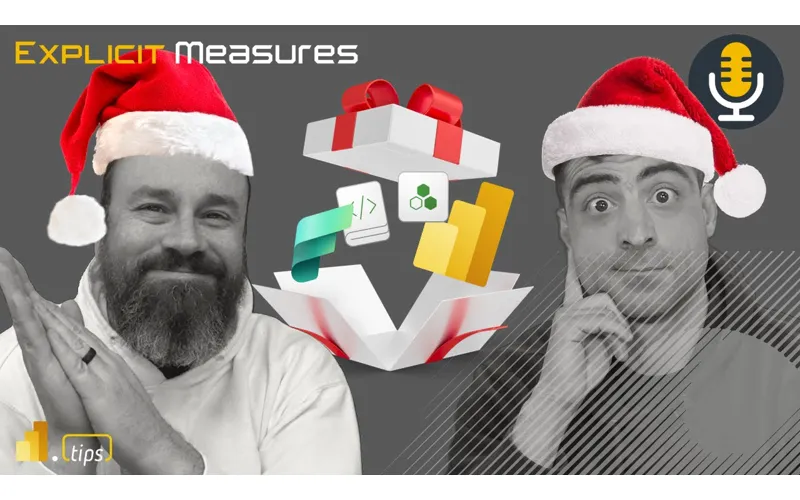
In this Christmas special of Explicit Measures, Mike and Tommy play Secret Santa with Power BI and Fabric feature wishlists—unwrapping ideas like Tommy’s “Notepad” concept for temporary, unsaved notebooks with reusable sticky cells, and Mike’s vision for integrated notebook experiences right inside Power BI Desktop. They also debate AI licensing, workspace variables, and why five monitors is the minimum for Microsoft Fabric development.
Main Discussion: Feature Wishlists — Secret Santa Style
Mike and Tommy take turns exchanging feature gift ideas for Power BI and Fabric, treating it like a Secret Santa exchange. The format is playful, but the ideas are genuinely useful product feedback.
Tommy’s Gift: Notepad & Sticky Cells
Tommy pitches a “Notepad” feature for Fabric notebooks with two key capabilities:
-
Temporary notebooks — Quick-run notebooks that don’t save. Just like opening Tabular Editor to view VertiPaq stats without creating a file, you could spin up a notebook, run BPA analyzers or view semantic model performance, and close it without cluttering your workspace with “Notebook 1” artifacts.
-
Sticky Cells — Reusable, customizable code cells saved in a side panel. These would support variables (like auto-inserting lakehouse connection strings) and be accessible from any notebook. Think of them as a personal snippet library with intelligence—knowing your default connections and adapting to your workspace context.
Mike loves the idea and pushes it further, suggesting notebooks could become a view inside Power BI Desktop itself—connecting remotely to service-based models with full Python and Spark support.
Mike’s Gift: Multi-Surface Development Vision
Mike shares his evolving preference for the web-based Fabric experience over desktop, driven by multi-monitor workflows. With enough screen real estate, he keeps lakehouses, semantic models, report pages, and notebooks open simultaneously across browser windows—something the single-window desktop experience can’t match.
He pushes back on Fabric’s new multi-tab experience, arguing developers with multiple screens prefer separate windows over consolidated tabs. The ideal workflow: full real estate across multiple items, touching lakehouse → model → report → notebook in parallel.
AI Integration and Licensing Concerns
Both discuss the fragmentation of AI tools—ChatGPT, Claude, Cursor—and the licensing complexity for organizations. Mike argues strongly for Microsoft’s approach of using external models within the Microsoft ecosystem, keeping prompts and data within Microsoft’s security boundary rather than sending them directly to model providers. The concern: direct-to-provider usage means your prompts contribute to training data, which enterprises want to avoid.
Identity and Career as Hobby
The episode opens with a heartfelt aside about how Power BI and Fabric have become part of their identity, not just their careers. Tommy shares an Italian language insight: in Italy people say “I work in” a field rather than “I am” a title, creating healthy distance from work identity. Both acknowledge they’ve crossed that line—this is hobby and passion, not just a job.
Looking Forward
The Secret Santa format surfaces genuine product friction and feature opportunities. Tommy’s sticky cells concept addresses real workflow inefficiency in notebooks, while Mike’s multi-surface vision challenges Microsoft to think beyond single-window experiences. Both are recording through the holiday break—a testament to their dedication (or obsession) with the data space.
Episode Transcript
Full verbatim transcript — click any timestamp to jump to that moment:
0:00 Heat. Heat. Good morning and welcome back to this
0:32 Special edition of PowerBI tips explicit metrics podcast. We’re doing a a Christmas special. We’re recording this early, so don’t worry, we’re not actually up on Christmas morning celebrating Christmas and doing a podcast, but but we could be we could be. This is this is for those of you who who don’t enjoy your family and want to, , take a little break away from them in the afternoon and listen to us yammer on about PowerBI and and data things. So merry Christmas, happy holidays to everyone. and just wanted to say hello and
1:05 Welcome to the podcast. Hey Tommy, how’s it going? Bon Natali, merry Christmas. Bonatal is ital merry Christmas in Italian. Mike, if it was up to you and I we talk about PowerBI and fabric on Christmas. We talk about it every day if we could. , we’re on Christmas break recording this episode anyways and slowing down around the the Christmas week and yet we’re still doing the shows and the podcast and recording things. So, yeah, we’re crazy. We like this stuff. I think this is we’re we’re all consumed by this data space. It’s hard not to think about it at this point.
1:36 It’s it’s it def it’s how you try and make your career part of your career and not define who who you are. I think in some ways PowerBI and fabric has defined a bit of who we are. and it just oozes out as as part of like our character now because we think about it and use it and leverage it so often these days. That’s interesting you say that Mike because when I was learning Italian they were talking about the differences in how people are in Italy compared to America because when you say what do you do like I am a marketer or I am a data analyst. in Italian they say I work in
2:10 And that’s like the word of verbiage that they use so people feel disconnected from their work or they don’t feel like that’s their identity but I think for you and I we embrace it I tell people all the time like I work in this but you got to understand it’s a hobby like if I won the lottery I wouldn’t just change like I would not open a deli I would open a deli but I would I would also [laughter] what am I talking about but I I would also making I would make sure that I’m still doing this at some capacity
2:42 Because it’s just the way my mind works. I would agree. I think of I’ve al contemplated like what happens when you have enough to retire? What does retirement look like? What I think about those things. What does it look like for the future? I’ve got plenty more years to go of working before I actually get to that stage. But I think to your point, Tommy, I think that’s what I would do. I think I would still stay in this data space. I would focus on the fun things that I enjoy doing, , experimenting, building little side projects, probably hopping on YouTube. It’s gotten so easy now to to create content. I
3:15 Probably build like a little mini sample projects and explain how to build stuff. I think one of the fun things that we did recently was we did a quick quick tips, I guess. Quick tips you do. Yeah, we did a little quick tip recently and it was all around building a streaming data set on a notebook and then using co-pilot to help you vibe code it. I also do think Tommy there’s something there’s something to say around this AI space that’s going to be very much enabling people who don’t normally build applications and programs to stay in tune with building things and
3:48 That’s another area that I think is I’ll pick my Christmas present. Oh okay. [laughter] [gasps] Well, as as it is a we do this traditionally, we typically give out Christmas presents. Tommy and I think about like, , looking at PowerBI and Fabric, our ecosystem. We step back and say, okay, what what Christmas gifts would we give each other in related to our data space? What would that look like for each other? Hey, what we really want for Christmas, not not ties or shoes or hats. Yes, true.
4:21 Well, we’d actually really be excited if we opened up on Christmas Day. And again, Mike, you and I also, we give the gift to each other. And I think it’s like two to three gifts depending. And we also say, would we actually take it or not? So, this is actually the first time all year me and Mike actually have to think of each other’s feelings. Yes. It’s very difficult. I [laughter] know. It’s really weird to see what other person would like. , so that’s our episode. So, what what we typically do in the episodes, we’ll I’ll give Tommy a gift. I’ll
4:53 Explain the gift. I’ll get his reaction to it. We’ll unpack what that what that looks like and then Tommy will then reciprocate and then give another gift as well. So, that being said, you want to jump in gifts? Do you have anything to introduction on? I guess traditionally we go through any like Christmas traditions that we go through. Yeah, I was at a Christmas party with my wife’s family this past weekend and all the little kids. I just realized, Mike, I’m better at talking to little kids than I am to adults sometimes. Probably because that’s where my intelligence is. [laughter] But they like me. They they’re on your level. They’re on your level.
5:25 I’m I’m very funny to them. but one of the things I I was asking them was what’s your favorite movie and what’s your favorite Christmas song? And I love hearing all the different answers even for kids today where you think that those all change. Right. Sure. It was amazing how much of the same songs and the same movies that our own generation was saying. So I’m not going to give you the classics because I want to hear yours. So, I’m going to forward that question to you, Mike. What’s your favorite movie during the holidays? And
5:58 What’s your favorite Christmas song? Or and again, Christmas song, I’m willing to break into two, like your traditional like classic ones, and then the more not secular, but more pop culture ones. Yeah. So, let me I’m going to give you we we just did this in our family recently. We asked the same question, believe it or not. something around like so I started asking like what was your favorite what was your earliest memory of Christmas like when do you first remember even to our kids like what was the first time you thought about yeah what were those first u interactions with with the holiday
6:31 So so to answer your question directly one of our favorite movies or one of the movies I think I enjoyed the Grinch is one of the movies that we would remember or or watch a lot around but this year we did did a new thing where we watched all of the Grinches there’s like three different movies of Oh, there’s like the new animated one. There’s the real Cumberbash one, the Illumination one. Yes. Yeah. There’s there’s there’s that that’s a new, , Grinch movie. And then there’s the live action one with I think with like Jim Carrey and then there’s like the original one which I remember
7:05 As growing up with it, but I did not realize the original Grinch was made in 1968. 24 minutes long, too. Yeah, it’s like a it’s it’s short. or it’s like a 30-minute movie, but , I guess like a special or something like that. But that makes sense. It’s and I think the the original was like literally them reading like the book and then having animation to go with the book pieces of that. but we watched all the movies this year and went through them and I think that’s I like Elf. I think Elf is a fun one, but I think of all the movies my wife really likes White Christmas. I can’t stand that movie. It’s just too
7:37 Long and it’s like what the heck? I don’t That one I’ll stay away from. But I think the Grinch one, I I enjoy that one. That’s a It’s a fun, light-hearted, shorter movie. I remember as a kid watching a lot of Charlie Brown Christmas. I think it was just on in the background and I didn’t really like that one. It just was on really. Yeah. No, and I do remember Home Alone. I don’t know if that’s actually it’s a it happens around Christmas. No, it’s a Christmas movie. And then so that one I remember that one I think some of the Home Alone ones was fun. I remember watching that growing up as a kid. and regularly watching that
8:09 And that’s probably one of the movies that come up that comes up most in conversation. when we’re talking with our family around the holidays, everyone talks about Home Alone. Like, we’re we’re always, “Oh, yeah, Home Alone.” And that seems to be a staple as well. So, it’s funny you say those movies because those were the same movies all the kids said. So, you just hit the gamut of even what today, , whatever generation we’re in, generation TZ Z or whatever, I don’t know, whatever. But whatever the kids are now, these kids, they’re saying the same movies.
8:41 That’s exactly what I heard. It’s like the the heavy hitters of Home Alone, which actually that house is like 25 minutes away from my house, which is cool. We haven’t visited, but yeah, it’s in Yeah, in Chicago. And then obviously The Grinch. And then obviously No one said Charlie Brown, though. No one said Charlie Brown. Yeah. I feel that was more of like my my family thing. That was maybe one that we just did. And I remember as a kid growing up, I liked Snoopy a lot. The character Snoopy and I had like this little Snoopy blanket that I would take with me everywhere I go. I was obsessed with
9:13 Having my Snoopy blanket. Yeah, I that’s hilarious. I always wanted the Charlie Brown tree. I thought that was just appropriate for me. But I It’s funny you say the elf and Grinch thing because I just heard that depending on what movie you like is going to describe your humor and your personality. Interesting. Because you’re either one or the other. You don’t find many people who think Elf and the Grinch are both hilarious. usually one per like for and I’m exact part of that for me. Elf like it’s fine but nothing really stands out to me. And
9:49 Then the Grinch though is for me that’s my also my favorite. That’s the one that will still to this day every single time I’ll be belly laughing. So it’s the song like to me it’s the song that you’re a mean one Mr. Grinch. No, it’s too scary to me. Yeah, but but regardless I’m a psycho. [laughter] He he did a really good job in that movie. So that that was a lot of like I I think it just it was it’s a simple simple movie. and it makes sense and it Yeah, that was that was a classic for
10:22 Me growing up, I think. All right. So what’s the song then for you that you It’s just like ah Christmas. what I I’ll have to go after. So it’s probably changed for me over the years. I think more recently the Christmas vibe is probably more of what what my wife likes and she she absolutely loves Mariah Carey. Oh no. Whenever that comes on like that’s like everyone knows that it’s it’s Christmas time and mom comes out singing the song and so like that that’s like one
10:57 Of the major things that we have. that’s probably one of the the things that remind us the most of Christmas. I do remember when I was a kid though, , we had a record player and we had a series of albums, just older music. I I don’t I can’t remember exactly which albums they were, but we had a series of records and I remember pulling out records at Christmas time and putting them on the record player and then getting the record player started to play the Christmas music. And when we did that, then we would get out like the bins of Christmas things and the garland. And then we start figuring out
11:29 How to, , decorate the tree and put up ornaments. That was like a Christmas tradition that we would do a lot as a kid is we’d pull out records or records of music and put them on and we’d play that and we would listen to it while throughout the house. So that was something I remember as a kid growing up with. that was probably when I asked the question, what was some of your earliest memories of Christmas? Yeah, that was one of my earlier memories. That’s a good one. I unfortunately know when my my last Christmas memory or when I felt like Christmas ended for me was when my dad for Christmas got me a flashlight
12:00 And I went, “Oh, I think Christmas is done for me now.” Because he was like, “Yeah, you could break windows with it, too, in case you get in an accident.” I’m like, “Oh, wow. All right, I guess I’m not a kid anymore.” So, no more toys. No more T-Rexes. [laughter] Well, it gets difficult the more the older you get as a kid because your presents seem to get larger and more expensive as you go. It just feels like that’s what it is. See? Yeah. But for me, like we do a secret Santa with my wife’s family every year and every year like there’s this like draw names. You could put all the
12:32 Stuff on a list. Sure. And I just like I don’t put anything in the list ever because I just say and I tell these people know this. If you get me anything with a Yankee symbol on it, I’m happy. I’m good. like it could be a bottle opener and I’m going to be like, “OH YEAH, THAT’S AWESOME.” And I really feel that way. Yeah. So, don’t think hard. Just it’s like that’s all I need. And my sister-in-law this year, bless her heart, she got me a Yankee wallet, which I needed, and a hat. And I’m stoked. That’s it. I’m a very simple person. But these are also things that you would like you you like them. And you wouldn’t
13:05 Go buy them yourself. Like you you would go buy them, but it’s like, , it’s nicer. buy them if my wife was you’ve been barred from [laughter] buying any more Yankees things. Like you’ve been told not to spend any more money on this. We already at that budget in January. So, , but no. Yeah, it’s it’s the same thing for me. The Christmas songs, I’m going to be honest with you, Mike. I’m becoming more into the Grinch because every year more and more songs I veently dislike. like I have an adverse
13:38 Reaction to maybe it’s because most of the songs are in a commercial now like if you watch a commercial it’s always a Christmas jingle and for whatever reason that gets me so upset that every song is like walking in a Honda Wonderland you’re like screw you Honda I’m not going to buy Honda anymore and I just don’t like that being said every year when it’s Christmas Eve and I start cooking because that’s again for us the feast of the seven fishes is that’s when I turn on the Andrea Belli’s Christmas
14:11 Album and his rendition of A White Christmas. I feel like I I turn into like my mother and I just start I start just crying and it’s not even like it’s not like something happened in my life. It’s just hits you in the heart. Yeah. Because then he starts singing in Italian and I’m like making seafood and like then I feel like I’m the kid again. And you’re like that was my tradition and just Belli is just awesome but you just hear I’m like cave la you’re like oh. So that that’s what that’s what hits home for me.
14:43 , I would I’ll also note here too like that’s that that is another I think thing around the Christmas season is when you get into that that mood or what things feel like it’s the singing the the music of things that really puts you in that space of like okay now this is this is that part of the season but that doesn’t happen for me until the 24th. That’s that’s true. Well, I feel like a lot of times with the older you get, the more you’re like working and then work is like all consuming until you get to a point where, okay, now I’ve done enough
15:15 Work. I can actually stand back and actually enjoy the Christmas season and step back for work for a bit. All right, with that, you want to move over to Christmas things? Let’s do it. I think it’s time for one of my favorite parts of the year. All right. Well, who do you want to go first? That’s like the hardest part of this whole thing is who starts this one off. I wish I wish I looked at who looked la who did it last year. I feel like I did it last year. So, Mike, I am going to give the floor to you. All right. So, I’m going to give you a gift this year. I’m going to, for the
15:48 Lack of better term, this one, I’m going to call this one model mayhem and and maybe this is a bit of a a gift for myself as well. , but I I love those. What What is it? I I gift you a bowling ball and so I can go bowling or something, ? I don’t know what it is. Yeah. So, something like that. , so I’m going to call this one Model Mayhem. And, , in Model Mayhem, it it’s going to allow you to anywhere there’s an AI something. It’s going to feel a lot more like VS Code. And, , in VS Code, when you when you use Visual Studio Code and you use Copilot,
16:21 There you have the ability of picking like different kinds of models, which model you’d like to use. , it doesn’t have to only be Chad GPT. You could use Claude, you could use other things. So I my gift to you this year would be a model mayhem where in in the tooling anywhere it exists where there’s models used inside fabric you’d have the same picker capability pick which model you’d like and that and that would allow you to wherever co-pilot exists and I again I would maybe change the term here co-pilot wouldn’t merely mean co-pilot
16:54 Anymore like this black box behind Microsoft it’d be more of like co-pilot is like an AI assisted something that you’re able to pick and use and and switch the model and use it to do different things. So if you find the newest models from chat GPT you can go into your notebook and you could pick those and use them from chatgpt. If you find working with claude in reports or having something from report side works better with a different language model you can use that model and you can pick it as a user. So I think that would be my gift
17:27 To you is just to give you a bit more control around what models are being used in your user. This is probably more focused on the developer creative experiences. Yes. I didn’t actually flesh this idea out very much like what would it look like in like co-pilot for home like how would you do that? Maybe there would be some controls like if you’re building like an agent, right? your agent, you you tell the agent, “Hey, I want you to use this model versus that model.” And then to the end user, they they wouldn’t they wouldn’t be any the wiser on which model they were using. You would just pick the
17:59 Model that you you want to use. This feels like one of those gifts that you open and you [clears throat] look at your wife and you go, “You sure we didn’t have this? I think this is in a house somewhere.” And then you realize that you didn’t have [laughter] That’s funny. That’s true. That’s true. You’re like, “I thought I got one of those last week.” Didn’t Didn’t Uncle Frank Uncle Frank, I think, gave me this last week. No. Well, not even that. It’s like I’m sure this has been in the house for years and you like we don’t we we never own this. Wow. I guess we needed this. So, this is one of those things, Mike, where and I’m going to actually enhance your gift. And that’s a
18:32 Christmas gift in itself here. Oh, there we go. Where I I like it, but I I I like you said, I think there’s a few more things bit of halfbaked here. I I’ll be a little honest, , just the only choosing a model, but let’s make it more like VS Code where not only in that model manager part, , you can also modify those custom instructions if you’re I knew you were going to go there with that, but I knew that I I will say I did think about that part of it. Yeah, I was thinking about no more cost to you.
19:03 Correct. And it actually saves you tokens if you use some custom instructions. But again, the whole thing just feels very blackboxy to me. And I don’t I don’t think I as a developer, right, of of one who’s building content in PowerBI, I don’t think I want it to feel so much like a black box. So, I’m just trying to give a bit more exposure to like, okay, what’s really being used behind here and Microsoft can is free to choose whatever they want for co-pilot and all their experiences, right? But I know they’re constantly like moving in or out different models. different behind the scenes to make sure these
19:35 Things spit out reasonable stuff and they’re not just arbitrarily spitt I feel like I would like to have a bit more control around that for the developer side and another maybe alongside this too Tommy as I think about fabric in general I would like to have like a in foundry IQ or Azure foundry you can do you can just build an agent and you just stick whatever model you want on top of it. You can do that in Copilot Studio for crying out loud. You choose which model you want. I
20:06 I feel like there needs to be like this general so I feel like what I would like as a developer person who builds stuff on top of fabric. I want like there’s we have a data agent that’s focusing more on like connecting data models and and giving information to that data agent and the data agent is then able to be like a representative to other agents. Hey, here’s stuff that I have. -huh. I feel like in I want a general AI just to show up like so just just not an not a data agent. I think I just want like an agent and just say here’s the
20:38 Instructions I want you to do. , let me give you for example, right? What I may want to do is I may want the data agent that I’m producing as a workload. I may want to feed it an image and say recommend for me six colors that would match this image or background or whatever the thing is. or take a here’s another here’s a report model review agent right I build an agent that goes through and says here’s some best practices on what we like to do for a company for this report and it scans through the report and then spits out some answers like to me that feels like something that
21:10 Should be able to exist inside fabric where you just have a general agent and I can talk to the general agent using an API and and interact with it and that’s something that I could use as a developer also it I think it would enhance some of the other experiences in PowerBI I’m going to go the other way because I think when I’m in like if when I’m in notebooks or if I’m in the warehouse PE there shouldn’t be a single agent because typically you’re doing multiple things that just because you’re in one product doesn’t mean there’s one agent needed. I want the ability when I’m in notebooks to choose an agent like the
21:44 Documenter like hey look at this notebook and what your goal you the the purpose of that agent is to comment and document and understand what’s going on in that notebook or the organizer like that role for that notebook for that agent is to organize those cells that I’ve messed up and clean it up a bit where or I’m a beginner so treat me like a beginner or I’m already a developer just give me code just spit out the code I need and put it in. I don’t want descriptions. I don’t want the fluff in the beginning or the end. Don’t tell me you’re right,
22:17 Just do it. So, I would love that ability to have different agents within each product. And so, outside of the model, give me one that actually serves a different purpose because I’m finding myself in different needs each time I’m in the same product. But I will the fleshed out version, even the black the, , the halfbaked. I’ll take it, Mike, because again, I thought it was in the house already. It should have been, but the fact that we don’t have it, let’s, , let’s make sure it’s part of the kitchen wear. The AI stuff is moving fast. Who knows how long it’ll take for it to get there
22:48 To a certain certain [snorts] part. I’m guessing it won’t be very long before something either more like this materializes or something like this changes. So, that would be my first gift. My first gift to you is called Model Mayhem and allows you to adjust your models across your experiences. All right. I like it. All right. So, I am up next. And this is one of those times, Mike, when you have two gifts. you were going to give one initially and then someone gave you something like oh can’t repeat that. So then you switch them up. So I’m going to give you my second gift first. Okay. So both of them I I’m really proud of both of them but I don’t want to
23:21 Notebook notebook right back to back. This is called application writer. So a lot of time and this is very geared towards you Mike because you’re building a lot of software a lot of applications and you one of the big things I’ve heard from you because I do listen surprisingly on the podcast one thing I hear over and over is you want to be able to connect your fabric data to those applications and you can and it is simple but you have to know what you’re doing. So what I’ve developed for you is almost like a new workload but I know it’s sorry it’s
23:54 Actually in now at warehouse the SQL database and the analytics writer a new button on the top called application writer and what it allows you to do depending on what data source you’re in in fabric it basically is like the power apps creator a new window opens you choose which data you need what you’re trying to do with it and then it will actually create that application or the packaging for you so So it’s actually going to not only give you the connection string which is what it does now but it will actually almost auto write the different things I need to read write
24:27 Edit okay these are the things that I need to do or Mike depending on the type of package you already have in VS Code or GitHub you can connect to your repo and say here are the things that this application does and it will autoimplement connection strings how to connect making sure that it can read or edit those tables and it will plug and play and connect to that data. data automatically into that GitHub repo or you upload a zip package that has all those files in it. So if you already have something like let’s say your themes file and you want to connect to a fabric database you had you’re like okay
25:00 It’s going to connect to all the JSON schema it’s going to auto look at that it’ll obviously verify that it may even provide some work trees so different branches for you so it’s not going to just go on your main one so you can choose which branch or look at each branch to verify and choose the best version of it but it just simply allows you Mike to not only have the connection strings but also implement that modification, the writing to the data and the reading of the data in the different screens or interfaces that you’re in. And again, this is available
25:32 In every place that you have a data source, databases, endpoints, and the warehouse. Nice. I like this. All right. So, let me give you my reaction to this one. So, this is I can tell you’ve been listening because this is spot on one of my major pain points [laughter] right now with with building things. And I’m I’m getting to a place right now. think thinking about where we’re in a very interesting time. I I thought we were in a I was really interested in PowerBI where it was adopted when it was getting started. It was very fun to get started with
26:04 PowerBI but it was it’s been a 10-year journey to get to where we are right now with a lot of adoption. It’s got of it’s hitting a lot of the the leader marks in a lot of the partners and Forester waves like there’s all these different marks that are saying Microsoft is leading this helm in data engineering with BI reporting. So it’s taken some time to get there, right? , one of the areas that I think is developing right now is a lot of realm like this agentic ondemand faster way of building applications. And so I fully recognize all those applications need to live on
26:37 Top of some data, right? They have to exist somewhere something. So in lie of that I’m looking at it going hm how much of my real application could be built like the data side the data system side could be built on on top of fabric and the reason I’m saying this is because I like the ease once you get once you get data into fabric it’s very easy to move it between the lakehouse and notebooks it’s very easy to move between a lakehouse and a data warehouse it’s very easy to move it from hey I have some real-time information coming in let’s make sure we
27:10 Send that real time data coming into fabric and then I can easily report on it inside my actual application. So I feel like because there’s such little friction between when where the data is and then how do I use it into reporting, I want to bring more and more of my data as quickly as I can directly into the fabric ecosystem. And I think that’s just that’s just how I want to design things. And I think to your point, Tommy, there’s I’m starting to see in the marketplace, again, back to this application writer. Mhm. I’m already seeing the marketplace
27:41 People are already vibe coding like there’s lovable, there’s base 44, there there’s another one I was just listening looking at the other day, but there’s all these like agentic ways of building applications. And when you build an application, there’s like three things you need. You need a way to store the data like a database something. You need security. So I need to be able to authenticate and get people in and around the app. And then you need some form of like a payment system like how how do you integrate? Those are like the three hardest things I say was like you have to kind
28:13 Of like figure those things out. And once you organize those things out, you then are able then producing an app on top of those things. And I’m oversimplifying the app building experience, right? But there’s other tools like using lovable and this other program called air table which is like a very flexible way of building things in the cloud and it just makes it easy to work with. And so it’s only a matter of time before all of the AI tools that build things automatically know how to
28:44 Authenticate, automatically know how to build reports [snorts] and and build data structures and then automatically know how to like, okay, we’re going to we automatically know how to integrate with like Venmo, PayPal, whatever. It’s just part of what how to do and the and the agent understands how to build these things for you. So I think we’re getting to an era of, , less around developers, but more around management and orchestration. If you can dream up these ideas, it can it can happen a lot faster. Yeah, I love it, dude. That’s awesome. this is great. , so good. This is something you think you’re going to use? So, Oh, I would 100% use it.
29:17 And again, to maybe further on the idea here, Tommy, I would probably even echo like this is like bringing like lovable base 44 aented like things directly on top of like in the fabric creation experience. Like it’s almost like being able to say I’m going to bring that in and say okay that that’s what you’re describing is my biggest pain point with using fabric and these agentic based tools because all the other tools use other open-source easy to integrate things. I can’t just go into these tools and maybe I could but I can’t just go in and say create
29:50 For me a SQL database in fabric and use that as my source system for all the data or I’m going to be [clears throat] writing and reading this data into lakehouses like store all the files that people upload into this lakehouse. It should be that easy. It should be as easy as integrate this integrate with Google authenticator or integrate with be able to log in with these things and it should just work. I was using cloud code and I was saying hey I need to connect to this data I want you to give me the best option here once like it’s a fabric database but D and went through and said give me some
30:22 Alternatives if you think that’s going to be too difficult to do because I don’t want to use all my tokens like well you could do that but you got to tell me how you’re going to sign in or just give me a CSV of that data and it told me how much easier it was going to be for the application you’re like dang like not that I can’t do it but I I agree with you you we have those connection strengths, but authentication is a really big part. Yeah, I agree with that. I think once those things get figured out, , it makes it much easier for people to
30:53 Use the tools, right? Is is once you iron out the experience of those basic integrations, everything else gets a lot easier. Cool. All right, so I think you’re up. All right, so you did the application writer. I like it. It’s a good gift. , this may be like a Sometimes you give a gift timing, you’re not sure if they’re going to really like it or not. , but we’ll see. , I’m going to give another one here called the enhanced lakehouse catalog. So, we’ve been talking a lot about like the fabric IQ. We’ve been
31:26 Talking about all the things that exist. , one of our one of our think general our gripes has been there’s a disconnect between like real usage of data. there’s been a disconnect between like all the way down to what’s in the visuals. it’s also a bit of a struggle to understand when you’re using analyze and excel on top of a data model in addition to having reports because you don’t get to see the analyze and excel items appearing inside the fabric space. So, I’m going to call this one enhanced lakehouse catalog, which really is the the mix of ontology, fabric IQ,
32:01 And it gives you the ability to add as much metadata as you want to anything that lives in fabric, right? , one of the things that we miss right now, which I think should should definitely exist, you can’t add any metadata to a table or a column or anything like that, and it just doesn’t seem to be working. It just it just needs more. So, I’m giving you the full experience. This this gift is the enhanced lakehouse catalog and it contains all the lineage things that you would need going from lakehouse through all the data systems all the way down to visual level details gives you all that
32:34 As one view. and then also it’ll add usage data against those things. So that way not only can you see holistically what your company’s doing and we’ve again heavily discussed this and as I’m as I’m unpacking this idea as I was thinking about this for you Tommy I was thinking this does make sense where the ontology should be used right that we should be able to have like references and the ontologies and maybe there’s many different multiple ontologies that are all linked together and then how do you find similarities and then build like a monolithic one that’s like everything in the business. We also
33:06 Talked about the backwards ontology or or the concept of that and this also thinks like it fits that that step where you’re you’re actually able to holistically look at the whole company and when we say the word customer we realize the customer information might have an entire semantic model bound to it. It might have individual tables in the lakehouse. The the customer may have multiple definitions. There may be a customer table for operations. There may be a different one for sales. But just
33:38 Being able to have a place where we can have all the information together and then have the conversation around that. I’m not going to talk about any of the business process because I think we could debate that all day long. How to make it work well, but just the focusing on the idea of everything you need to find is part of the lakehouse. This is definitely a gift that I turn to my wife go, I know I got this before. I feel like it’s like a previous year’s version. I probably I probably have like we didn’t have an autotology before. No, we didn’t have an autoto. That’s what I’m saying. It’s like it’s like getting Madden 2007 or whatever. You’re like I think I got the video game, but
34:10 This is the updated version. Yes, [laughter] exactly. Yeah. Like this is this year’s version. Tommy, you had Madden 95. I just gave you Madden 25. [laughter] That’s what it feels like. I can play the game now, but this feel like this is just going to be a better game now. Actually, what? This is This is the most This is the modern version of what is it? NFL Blitz. Oh man, remember that one, dude? If you could just get me that, I’d be happy. , right. Blitzing if fabric when I’m bored, when I’m waiting for something to load, just blitz pops up. Yep. Yep. , no, I I think the key the key word you said in this gift is setup where it
34:45 Does the setup for you because I think this is how that works. I don’t know. And honestly, I don’t care at this point. because that’s what I’m concerned with what what we’ve done already with the lakehouse and the one lake catalog and more importantly what we’ve seen with an ontology is like I think again the biggest gripe right now is I have not seen a complete ontology yet and if I did I don’t know what it looks like. more importantly, I don’t know what it’s supposed to do. Yeah.
35:17 And I think to see that connected to everything else is just going to give me a to your point at the very least give me a better idea of my definitions and what the heck’s going on in my tenant. And that’s a win for me. Now, what ontology can do and the application of it fine, but right now we feel like ontology is making things a little more confusing for us and what our definitions are. So, yeah, you got to give me that that setup. This is something I’m absolutely, like I said, I already have it. I’m just going to update my firmware. I’m going to update
35:49 The version with a new licensing that you gave me. So, I now have the latest version. So, thank you. Thank you very much. I like it. It’s not going to be in a sense the best gift, but it’s going to be essential to make sure this one of the first thing we’re going to do when I get back to work is update that software so it’s working. Yeah, it’s it’s a it’s a it’s a practical gift. I But I think this is something that’s needed. I think that Microsoft has been doing a good job in this space. I think it’s getting better. But if I if I look at like some things that I’ve observed one one is Microsoft was deprecating master data
36:24 Management inside SQL SQL server I think is what it was. So SQL server has this version of like master data things like things that are master data. There is I believe a tag inside fabric. I think you can use a tag on a data table or data things. You can call data master data. So you can tag things as master data inside fabric as well, which is nice. I like that idea as well. But when I step back and say, okay, well, what does master data need? And I I think about the catalog, it seems like they integrate well here. The enhanced catalog, I need the lineage of everything. I need to know where this
36:55 Master data is being picked up from. I need to be able to trace it down to where it’s being used. I think as an admin, we want more of these capabilities, right? So I I see this one catalog experience being two parts, right? one, it’s an admin to help them govern and see all the things that are inside their their world, but also it’s it needs to be like a discovery tool, right? So, when you’re giving these things out, people don’t know what to do with this stuff. You could give , I could give you a bunch of lake house tables, but if you don’t understand what to do with them, like you’re off on your own and you may build something that’s just totally
37:26 Wrong. And that’s that’s possible, but how do you not do that? Like, how do you help guide them along so it’s better? It’s interesting that you said tags. That’s not my second gift, but I’m going to add it on to yours and just say it’s an add-on or plugin that we’ll just buy for people and it would be called tag manager because right now you can tag things, but they behave in the admin settings. It’s hard to it’s not hard to do to tag something, but , you have to manually go through the settings and you have to do one in individual and then when you actually want to filter or
37:59 Quickly see what’s tagged by certain things, it’s I feel like it should be much more intuitive. It should be something like, hey, I want to see tagged everything here in this workspace because it’s a quick it’s almost like a quick filter, a quick categorical view. So tag, we’re going to add on here. The plugin, the add-on you can get that we’ll pay for with the gift card is tag manager to this ontology view where any workspace you’re in, you may have some saved tags. You just click boop. I want to see all my process tags that just quickly filters. It’s like almost like a quick filter for everything.
38:31 So I think that currently exists inside the lakehouse. What I don’t know though is Tommy is if you’re inside a particular work space. Yeah, I know there’s advanced filtering things and I think you can. I’m just double checking right now. But again, I want quick view explorer and quick filter. So, I can save what tags are on the menu bar as you Yeah. Yeah. It’s just a better way of expo. , I think you can you can filter by type and workload and owner. But I think if you have tags on items in a workspace, I think it also gives you
39:02 The ability to I think it gets you the ability maybe it does, maybe it doesn’t. I I don’t know. Right. That that feels like this is to your point earlier, Tommy, if this doesn’t exist, [laughter] I I I would have assumed that this already like this would have been like we already have this gift. This should already be in here. If that doesn’t exist, I’d be surprised. Yeah. All right, Mike. I’m going to end it with my last gift and I think you’re [clears throat] really I think you’re really going to like this. And we’re calling this note pad.
39:34 One of the things that you we obviously know books are a big part of our lives now and we had the conversations with Emily and we’ve talked about a lot of different things. I think we have one coming up as well. oh no, we just talked about notebooks I believe. Yep. if I have my order everything in order and notebooks are great especially the one-click notebooks or when you’re trying to do something but there’s some problems in terms of every time I want to open a notebook or do the oneclick notebook it creates a new one and I’m
40:06 Starting fresh with a blank sheet typically I’m trying to do a lot of simple things maybe I want to quickly view something with the oneclick semantic model now I have a new notebook called notebook one so I have to make sure to rename it so Notepad is two things. It is a quick access to a notebook that does not save. So I can quickly run through the gamut if I want to do that oneclick notebook, but I just want to view it now temporarily. I don’t need to save it just to view the tabular data. Just like every time I open tableabler editor and do vertipac engine, it doesn’t save a
40:37 New file. It’s just a quick view. So, Notepad allows me to quickly run through a cells, run Spark on a workspace in a lakehouse, but not necessarily save the notebook. But more importantly, I know how we’re going to add another right-hand pane. And just like you have those quick snippets right now that are saved by Microsoft, I have my own saved cells with variable support. And it knows the variable like it’s you save these sticky notes, so to speak, or sticky cells we’ll call. Actually, that’s what that’s a much better name.
41:09 Sticky cells where it’s like, hey, do connection and do a data frame and do the, , info view or the schema of everything. Well, it knows if I have a default connection to a lakehouse, it just automatically does that connection string in there once I insert it as a new cell. All I have to do is pick a table and then I can run that and I I can save I can customize this as much as I want. I can have as many sticky cells and organize them as I want. So I can be in any notebook and typically I’m doing a lot of the same things. I don’t want to open that one notebook that I know has a lot of those saved queries that I
41:42 Like. I want to quickly be able to access the ones that I’m using constantly again. So I have like a sticky pad sticky cell manager where I can, , it’s the not the var like workspace variable support. It’s specific to the notebooks. So I can say like, , autoinsert based on certain conditions. So I have the ability one temporarily run a notebook that’s not saved or two choose from all my sticky cells that I’ve customized. So it’s a little better version enhanced version of the snippet view right now. H interesting. I know I would not have
42:14 Put that feature together with things. Hm. So let me ask a let me ask just a clarifying question so I can understand is your expectation is I’m going to ask just to understand where where I would use this present. Mhm. let’s say I’m on a report page. I’m in the report. I’m in the report or I’m editing the report. Is this something that would be a panel that would fly out on the right hand side? It would not be with the report. It would be when you’re viewing the semantic model. So you’re talking in the semantic model side. So basically being able to split
42:45 That screen into two. Here’s the semantic model side and here’s the the your your notepad sticky cells or is typically the sticky cells yeah are going to be with the notebook. But when I want to say model performance or the the BPA analyzer I don’t necessarily need to save that notebook. I just want to quickly run the BPA on that model or I want to view the model performance or all those community notebooks, right? I don’t necessarily want to save that per report. I just want to run that one time.
43:18 Sure. So those notepads or those notebooks that either are temporary, , are a temporary run. Well, just a quick I can quickly run that without actually being a new notebook saved or they’re just cell sticky cells I have in in any notebook that I’m editing. I like it. I think I I like this one. I think I think this definitely has a place for it. I think I like where this is going. I would probably ask to extend that experience in more places than just the semantic model. I think it’s useful
43:50 Multiple places. Yeah. Okay. Sure. I’m almost thinking even again this is probably something that’s a bit too much here, but like I’d almost feel like this is something where we have DAX query view in desktop. We have we have timal view for for managing the model experiences, right? Maybe there’s something around like a new notebook view, right? And so maybe the notebook becomes part of desktop as well. Yeah. So you have like the on the lefth hand side you have the different experiences and maybe you go down to the bottom
44:21 Where it’s just like hey we’re just going to drop in notebooks and you can remotely connect to that model that’s in the service and it’s got Python and Spark and all the things behind it and you can run a Python notebook or a Spark notebook and it just knows how to run things on top of that. I think that I think that would really interestingly make sense in that way. And then also when you’re in the service, I would have the model and or the notebook. I will say this to Tommy already today I’m spending a lot more time with I like the the web experience of just creating things. , I’ve been saying this
44:53 For a while now and it’s it more centers around the idea that I can have multiple windows open at the same time and I can interact with different things at in same the same places. Like I can have the lakehouse open. I can see all the tables. I can query the tables and see what the tables are producing. I can have the semantic model open. I can make new measures as I’m making new columns. And then I can go over to the report page and then build report pieces as the model is basically updating itself as I’m building the other things. So I really do feel like because I have a lot of screen real estate. I don’t have
45:25 To relinquish myself to one view. And this is maybe one of the areas why I don’t like I don’t really think I like Tommy the new fabric multiple tabs oh experiences because I don’t typically work in a single browser ever honestly like I’m on a machine that has plenty of of real estate and if I’m a developer I’m using the full real estate I’ve got multiple screens I’ve got multiple windows open I’m touching multiple things across lakehouse models reports all at the same time and possibly even
45:59 Notebooks. So to me that just feels more natural to have that open and much larger experiences. It’s so funny when people see my office for the first time they go, why do you have five screens? And my response now is two words, Microsoft fabric. Yeah. Y 100%. Now the notebook thing in the desktop is interesting because that should theoretically be more than possible because if I want to run copilot right that’s not copilot running on machine machine I have to connect to a workspace
46:31 And it has to say that copilot’s running from where so if I’m running a semantic model even if it’s direct lake maybe that’s the only place it’s available it already knows what workspace I’m in. Yeah. So let me connect that way and just run off the service. That’s interesting Tommy. I would I would also feel like that’s something else like VS Code does that today currently where VS Code connects to like a GitHub copilot experience. Yeah, but you have to install the like minion on your machine to do the Spark extension for desktop. So fine what that’s doing but yeah I’m just saying I guess I’m I’m not
47:03 Worried about the technical pieces of that. I would just be more of like Microsoft make it work thing. Right. So yeah, if I’m on if I’m in PowerBI desktop right now, I have to use VS Code to get all the enhanced AI things out of it. Oh yeah. Yeah. Why why can’t I just lift whatever the GitHub copilot thing is experience is and just put that inside desktop, right? Why wouldn’t that just be there? , if I’m really going to be developing with AI and things, I think you’re going to Well, let me say this way. as a company that builds software and uses AI and does things with AI to help them
47:34 Build software. I think it’s very essential for companies to start thinking about like how do you get your hands on the AI, what AIs are you actually using and how do you integrate them with other stuff. Yeah. So what by that is I don’t want to go out and buy a chat GPT license, a cloud code, a cursor license. I don’t want to have three separate licenses, nor do I want to send those companies my data. What I feel more comfortable around is having Microsoft use those models inside the Microsoft ecosystem and send my queries to those models to use the models as opposed to
48:08 Going directly to the source systems because whenever you look at the legal the legal ease like when you go to chatgpbt.com and use an AI right there directly all your prompts are being used and they’re using that for like research or whatever your prompt may not exactly show up in other code but there’s been a whole bunch of like vulnerabilities and weaknesses where they’re using prompts and other things to help it become better, more useful, which is great. I think it’s help that’s a good idea. I just don’t want any of my prompts or tokens to be used in the training of the next program. And I feel
48:41 Like Microsoft has a little bit better of a story here of use their infrastructure and and use your own prompts. I love it. All right, Mike. Well, I think that’s all the gifts. Yeah, we went through I didn’t think we were actually going to get a full hour, but we’re pretty close to it right now. So, thanks for a wonderful Christmas gift here, Tommy. It’s fun talking about like neat neat new ideas where we where we think the product should go and what things we find most interesting and even a little bit of parts here where we see there’s a little bit of friction on how to make things better for us. That being said, thank you all very much for listening to this episode. We hope you
49:13 Had a great Christmas and a good holiday for you enjoying that time with friends and family. That being said, if you like these episodes, if you want to get these episodes as soon as they’re published, you’re more than welcome to subscribe to them directly on our YouTube channel. So, we we highly recommend you go join us over there. Join our community. and you’ll get the episodes and videos as soon as they’re recorded right there on that YouTube channel. Tommy, where else can you find the podcast? You can find us on Apple, Spotify, wherever you get your podcast. Make sure to subscribe and leave a rating, and it helps us out a ton. Do you have a question, idea, or topic that you want
49:45 Us to talk about in a future episode? Head over to PowerBI tipsodcast, leave your name and a great question, and finally, join us live every Tuesday and Thursday, 7:30 a.m. Central, and join the conversation all the PowerBI tips social media channels. Thank you all very much, and we’ll see you next time.
Thank You
Want to catch us live? Join every Tuesday and Thursday at 7:30 AM Central on YouTube and LinkedIn.
Got a question? Head to powerbi.tips/empodcast and submit your topic ideas.
Listen on Spotify, Apple Podcasts, or wherever you get your podcasts.