
Why I'm Burning Down Every SaaS Tool In My Business
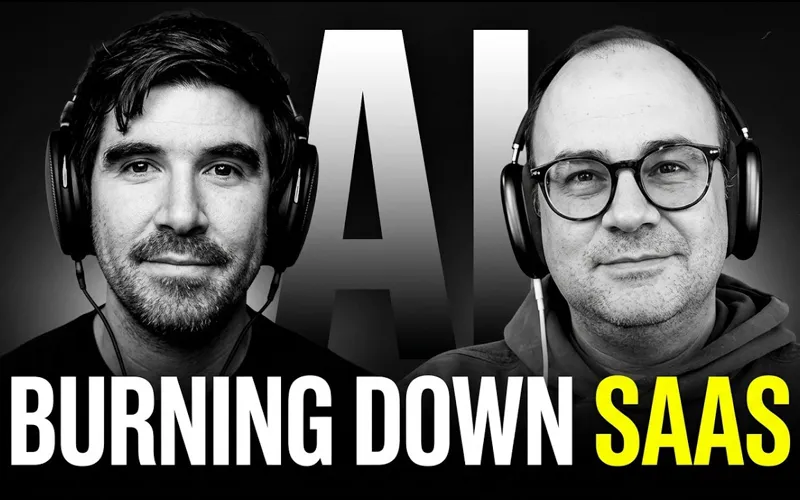
The shift most teams still do not see coming
Most businesses still buy software like it is 2018.
They stack app on top of app, glue them together with brittle integrations, then wonder why their process still feels slow, expensive, and weirdly manual.
That model is cracking.
In this conversation, the argument is pretty blunt: the next generation of business software is not going to be a larger pile of SaaS subscriptions. It is going to be agent-driven, context-aware, and increasingly custom.
That does not mean every packaged application disappears tomorrow. It means the center of gravity changes.
Instead of forcing your team to learn ten interfaces, the interface starts coming to them.
SaaS is not dead, but it is losing altitude
Traditional SaaS solved an important problem. It gave businesses fast access to capabilities without requiring them to build everything from scratch.
That was the right move for a long time.
The problem now is that many SaaS products have turned into rigid operating constraints:
- you adapt your process to the tool
- you pay for features you barely use
- you duplicate data across systems
- you manage permissions, exports, sync jobs, and edge-case workarounds
- you still end up opening Excel to actually get work done
That last one is the joke nobody escaped. Excel has outlived half the software industry for a reason.
The modern alternative is not “replace every app with a giant custom platform.” That would be a terrible idea for most teams.
The smarter alternative is this:
- keep core systems where they make sense
- replace workflow friction with targeted custom experiences
- let agents orchestrate the messy parts
- use software components and models more like utilities than monoliths
That is the real disruption.
Agents become the front door
One of the strongest ideas in the discussion is that agents should become the primary interface to your applications, not a bolt-on chat widget duct-taped to the side.
That distinction matters.
A bolt-on assistant answers questions. A real agent interface helps users do work.
For analytics teams, that can look like:
- describing a business question in plain language
- having an agent find the right data source
- generating a starter transformation
- suggesting semantic model changes
- producing draft measures or report layouts
- explaining tradeoffs before anything gets published
That is a much more important shift than “AI can summarize my dashboard.”
It turns the software from a passive tool into an active collaborator.
Why this matters for Microsoft Fabric and Power BI
This is where things get interesting for our world.
Microsoft Fabric already brings together storage, engineering, SQL, notebooks, semantic models, and reporting in one broader platform story. Power BI remains the business-facing analytics layer most teams actually live in.
But there is still a giant gap between:
- raw business intent
- data preparation
- modeling decisions
- final report delivery
That gap is where consulting hours disappear, handoffs multiply, and business users get stuck.
Agents can close part of that gap.
Imagine a Fabric-native workflow where a user can say:
I need a customer retention view by region, using the latest subscription data, and I want to compare rolling 12-month performance versus prior year.
A good agent-enabled experience could:
- identify the relevant tables
- propose the join path
- draft transformation logic
- recommend semantic model structure
- generate starter DAX
- surface assumptions that need confirmation
- produce a first-pass visual layout
That is not science fiction anymore. That is a product design problem.
The real opportunity is smaller, faster, and more custom
A lot of service businesses are wildly overtooled.
They buy generic platforms built for everyone, then spend months compensating for the fact that those tools were not designed for their exact delivery model.
With modern AI tooling, many of those gaps can be closed with small focused builds instead of full software initiatives.
That opens a big door for consulting firms and internal innovation teams.
You do not need to recreate Salesforce, Jira, Notion, Airtable, and six automation layers from scratch like a maniac with a whiteboard and too much coffee.
You need to identify:
- where the current stack creates drag
- where custom workflow creates leverage
- where agent interfaces reduce complexity
- where data and context can be reused across the business
That is a much sharper strategy.
Context is becoming the real moat
Another idea buried inside this conversation is that the best “second brain” setup may not be some magical all-in-one platform.
It may simply be:
- a strong model
- a well-structured repository
- markdown files
- usable context
- repeatable workflows
That sounds almost insultingly simple, which is usually a sign it is right.
The issue is not whether your business has data. The issue is whether your systems make that data usable by people and agents.
For Power BI and Fabric teams, this has serious implications.
Your semantic model, business definitions, deployment patterns, documentation, and project notes are no longer just team artifacts. They are agent fuel.
Messy context leads to dumb automation. Well-structured context leads to leverage.
Consumption-based software changes how we build
The conversation also points at a broader economic shift: more software experiences are moving toward pay-for-what-you-use models.
That matters because it aligns much better with agentic systems.
Instead of buying giant licenses for broad static functionality, businesses will increasingly pay for:
- inference
- storage
- execution
- transformation
- orchestration
- task-specific software behavior
That creates more flexibility, but it also demands better design discipline.
If every interaction costs money, then sloppy prompts, bad model routing, and unnecessary compute become operational waste.
Welcome to the future, where your architecture diagram now has a line item for “accidentally burning money with enthusiasm.”
What consulting teams should do right now
If you work in analytics, data, or Microsoft Fabric, this is not a “watch and wait” moment.
There are practical moves to make now:
Audit your SaaS sprawl
Map the tools your team uses across delivery, operations, knowledge management, reporting, and communication.
Then ask:
- which tools are system-of-record platforms?
- which tools are just interface layers?
- which workflows could be replaced by a lighter custom experience?
Design around workflows, not apps
Most teams talk about software in nouns. They should be thinking in verbs.
Not “What app do we use?” But “How does this work actually happen?”
That shift changes everything.
Treat your documentation like production infrastructure
Agents are only as good as the context they can access.
If your project notes, business definitions, semantic conventions, and architectural patterns are scattered or stale, your AI layer will inherit that chaos.
Build one internal proving ground
Pick one painful internal workflow and rebuild it with:
- clear context
- a small custom surface
- one or two targeted agents
- measured outcomes
Do not start with grand transformation theater. Start with one workflow that annoys your team every week.
That is where the truth shows up.
Final thought
The future is probably not “no software.” It is also not “one giant SaaS suite to rule them all.”
The future looks more like this:
- core platforms where they make sense
- custom workflow layers where leverage matters
- agents as the operating interface
- context as the strategic asset
- analytics systems that help people act, not just observe
For Microsoft Fabric and Power BI teams, that is a big deal.
Because once agents start becoming the front door to data work, the winners will not just be the teams with the best dashboards. They will be the teams with the best workflow design.
And yeah, a lot of bloated SaaS tools should probably be nervous.
Watch the full conversation
If this topic hits a nerve, it should. The shift away from rigid SaaS stacks and toward agent-first workflows is already underway.
Watch the full video here:
Why I’m Burning Down Every SaaS Tool In My Business on YouTube
Follow PowerBI.tips on YouTube
If you want more content on Microsoft Fabric, Power BI, AI workflows, and where analytics product design is heading next, follow PowerBI.tips on YouTube.
We are building more content around:
- Microsoft Fabric strategy
- Power BI development patterns
- AI-assisted analytics workflows
- real-world product ideas for data teams
Subscribe here: