
Microsoft Fabric
PowerBI.tips isn’t just Power BI — it’s also a one-stop shop for Microsoft Fabric knowledge. We cover what matters (and what to ignore) through practical posts and podcast episodes.
Fabric on the Podcast
Many Explicit Measures episodes focus on Fabric strategy, features, and real-world adoption.
Tools + workflows
We build and share tooling that helps teams create better outcomes faster.
Recent Fabric-related posts
A rolling set of posts and podcast write-ups that mention Fabric.
Oct 24, 2026
How Deplavity Was Born (and Everything We Made Because of It)
On Explicit Measures episode 573, Mike Carlo tried to say "deployment savvy" and invented Deplavity instead. Here is where the slip happened, how it turned into a fake prescription drug, and every video, ad, and jingle made because of it.
Oct 20, 2026
Fabric Deployment Plan - Ep.573
Fabric deployment plans let you order deployments and run notebooks or pipelines before and after each item lands, which finally gives data a place in the release. Mike Carlo and Tommy Puglia work out which teams should reach for a plan, which should stay in Git and GitHub Actions, and why both would wait for GA.
Oct 15, 2026
Ontology Agent - Ep.572
The Fabric IQ ontology agent can draft an ontology from a lakehouse, and it still cannot finish the job it just offered to do. Tommy Puglia and Mike Carlo hold the preview out of any workspace a client depends on.
Oct 13, 2026
Fabric Notebook Toolkit - Ep.571
Microsoft's Fabric Notebook Toolkit lets an agent you already pay for drive notebooks from a CLI. Tommy Puglia and Mike Carlo treat the preview as a tool to learn, not a pattern to hand to every workspace.
Oct 8, 2026
PADU and Fabric - Ep.570
Tommy Puglia borrows a four-bucket scale from Fatal Risk and asks where Fabric patterns land: preferred, accepted, discouraged, or unacceptable. Mike Carlo keeps the answer tied to the job, not the artifact.
Oct 6, 2026
Where Writeback Belongs – Ep.569
An anonymous mailbag asks whether Power BI should let people act on a number without leaving the report. Tommy Puglia and Mike Carlo put writeback in Fabric apps, keep the report for consumption, and treat translytical task flows as the exception.
Oct 1, 2026
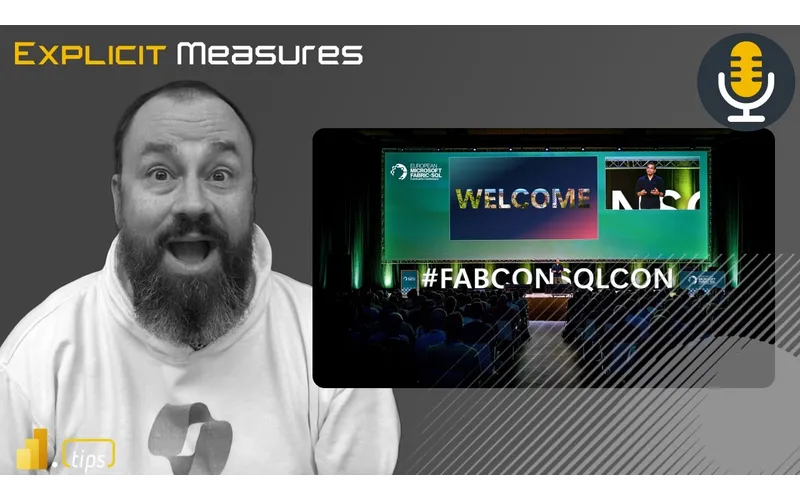
FabCon Barcelona - Feature Draft – Ep.568
Tommy Puglia and Mike Carlo draft a team from the FabCon Barcelona feature list, starting with Fabric app backends and the ontology authoring agent. The picks that follow are pay-as-you-go capacity, the Fabric notebook toolkit, deployment hooks, and text search in semantic models.
Sep 29, 2026
The Right Model for the Task – Ep.567
Tommy Puglia and Mike Carlo use Kurt Buhler and Eugene Meidinger's Tabular Editor piece to decide which model and effort level belongs on a Fabric task. The same hour covers FabCon Barcelona's Fabric app backend, semantic views, and why monthly active agents may matter more than monthly active users.
Sep 22, 2026
Your Identity and Power BI – Ep.565
Tommy Puglia, Mike Carlo, and Kurt Buhler spend this episode on what is left of the Power BI identity once Microsoft Fabric and agents are part of the job. The skill that still decides the work is judgment: listening to the business, and staying critical of what an agent hands back.
Sep 17, 2026
Self Aware in Data and AI Literacy – Ep.564
Power Query is moving a set of cloud connectors from ODBC to ADBC, and legacy Power BI Q&A now stays through February 2027. Kurt Buhler joins Tommy Puglia and Mike Carlo to sort out what data literacy and AI literacy require once Microsoft Fabric and agents make it easy to build faster than a team can review.
Sep 15, 2026
Fabric Apps Fit into the PBI World – Ep.563
Fabric Apps can own every pixel of a data experience, and Kurt Buhler is not ready to hand them the executive dashboard. Tommy Puglia and Mike Carlo spend the hour on where a Rayfin app fits beside Power BI, and on the design system, the token bill, and the research bench a team needs before it scales.
Sep 10, 2026
The Fabric Handoff – Ep.562
Tommy Puglia and Mike Carlo spend this episode on how a Microsoft Fabric project moves to a team that has to run it. Their model is I build, we build, then you build, and it holds when leadership, trust, and the team's own context stay in place after the builder steps back.
Sep 8, 2026
Using AI for Data Viz – Ep.561
Tommy Puglia and Mike Carlo read Rituparna Das's Nightingale guide to using AI in data visualization without an enterprise license, and they ask what those three workflows become when the output is a Power BI report. They also take apart a Fabric warehouse medallion best-practices post and a private-link path for copying data to Snowflake.
Sep 3, 2026
Data Agents Got an Upgrade – Ep.560
Foundry can now find Fabric data agents in the OneLake catalog and attach more than one of them to a single agent. Tommy Puglia and Mike Carlo walk through what that changes, from the 15,000-character instruction limit to a CU bill that still deserves a hard look.
Sep 1, 2026
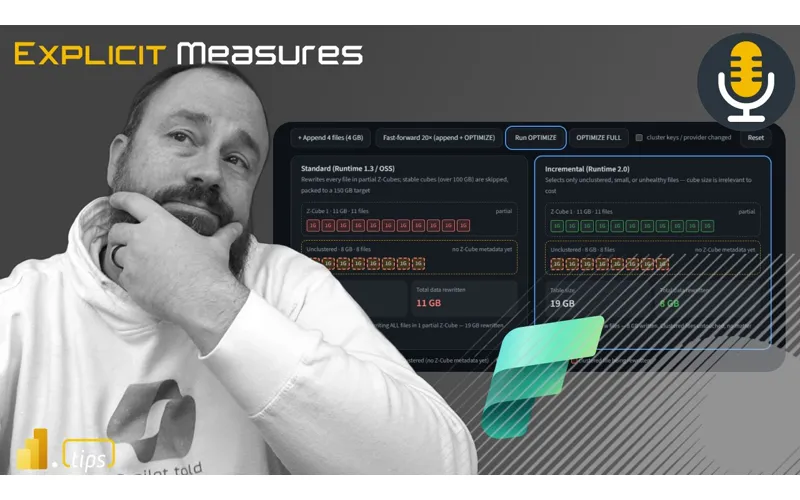
Fabric Liquid Clustering – Ep.559
On Explicit Measures, Tommy and Mike explain liquid clustering for Delta Lake tables in Microsoft Fabric and why Fabric Runtime 2.0 changes the cost of keeping that layout healthy. They walk Miles Cole's incremental optimize example and Mike's rules for when a Lakehouse Spark job is the right transform.
Aug 27, 2026
Medallion Patterns are Changing – Ep.558
Tommy Puglia and Mike Carlo spend this episode on Microsoft's new guidance for choosing a medallion pattern in the Fabric Data Warehouse. Bronze, silver, and gold still describe the work; the open question is whether a warehouse belongs in every layer.
Aug 25, 2026
LLMs: What Data Viz Teaches Us – Ep.557
Eva Sibinga's Nightingale essay argues that large language models hallucinate by design and are sold to look helpful before they are right. Tommy Puglia and Mike Carlo take that diagnosis into Power BI and Microsoft Fabric: a harness of MCP servers, skills, and validated context, plus a prototype refined in stages, is how you keep the visual honest.
Aug 18, 2026
Anonymous Rayfin Fabric Apps – Ep.555
Anonymous data access lets a Rayfin app take a public write — a contact form, a game score, an outage report — and store it in a Fabric SQL database without an Entra account. Mike ranks that capability third: the case for Fabric apps is still that the data stays in Fabric, and that an agent can build and fix the app.
Aug 13, 2026
Fabric as a Backend – Ep.554
Mike has been building apps on Fabric as a backend since January, and he's coining it FAB. The case isn't that you already own Fabric — it's that the workspace identity, git integration, and SQL database remove the wiring you'd otherwise do by hand in Azure.
Jul 21, 2026
The Hype of Rayfin – Ep.547
Mike is deleting paid subscriptions and rebuilding them as Fabric apps; Tommy wants to know who maintains all this and whether enterprise security teams will ever allow it. Plus the licensing discovery of the episode — agents talking to semantic models over XMLA with no Power BI Pro license required.
Jul 9, 2026
Using Harnesses for Fabric Projects – Ep.544
A mailbag question about request tracking turns into the clearest description yet of what a working harness contains: skills, agents, organized context, and the ability to talk to other harnesses. Plus Mike hits real Rayfin limitations trying to build a simple forms app.
Jul 7, 2026
App Usage in Fabric – Ep.543
"I built 35 reports this year." "Did anyone look at them?" Mike and Tommy dig into measuring app usage properly — active users over a rolling window rather than raw opens, tied to the business outcome the app was supposed to move.
Jun 25, 2026
Self Service with AI Part 2 – Ep.540
Part two picks up at the skills and validation layers of Anthropic's analytics stack, and Tommy arrives at a hot take he'll defend: no agentic solution on your Fabric data until governance is in place. Along the way — why perspectives are Power BI's most untapped feature and why Microsoft needs skills for models.
Jun 11, 2026
All About Rayfin – Ep.536
Rayfin lets you build full applications on top of Fabric, and Mike calls it the biggest Microsoft release since Power BI Desktop. This episode covers what Rayfin actually is, why the semantic model matters more than ever, and the handoff problem nobody on your team has solved yet.